> ## Documentation Index
> Fetch the complete documentation index at: https://laminar.sh/docs/llms.txt
> Use this file to discover all available pages before exploring further.
# Observability for Claude Agent SDK
## Overview
Laminar is an open-source, OpenTelemetry-native observability platform for the Claude Agent SDK. Trace, debug, and monitor every agent turn, tool call, and subagent spawned by `ClaudeSDKClient.query` and the module-level `query` function. Self-host via Helm or use managed cloud.
[Claude Agent SDK](https://docs.claude.com/en/api/agent-sdk/overview) (formerly Claude Code SDK) lets you call the same agent that powers Claude Code from your own code. It handles process management, tool execution, and model calls, and exposes a `query` function (TypeScript) and `ClaudeSDKClient` (Python) for driving a session.
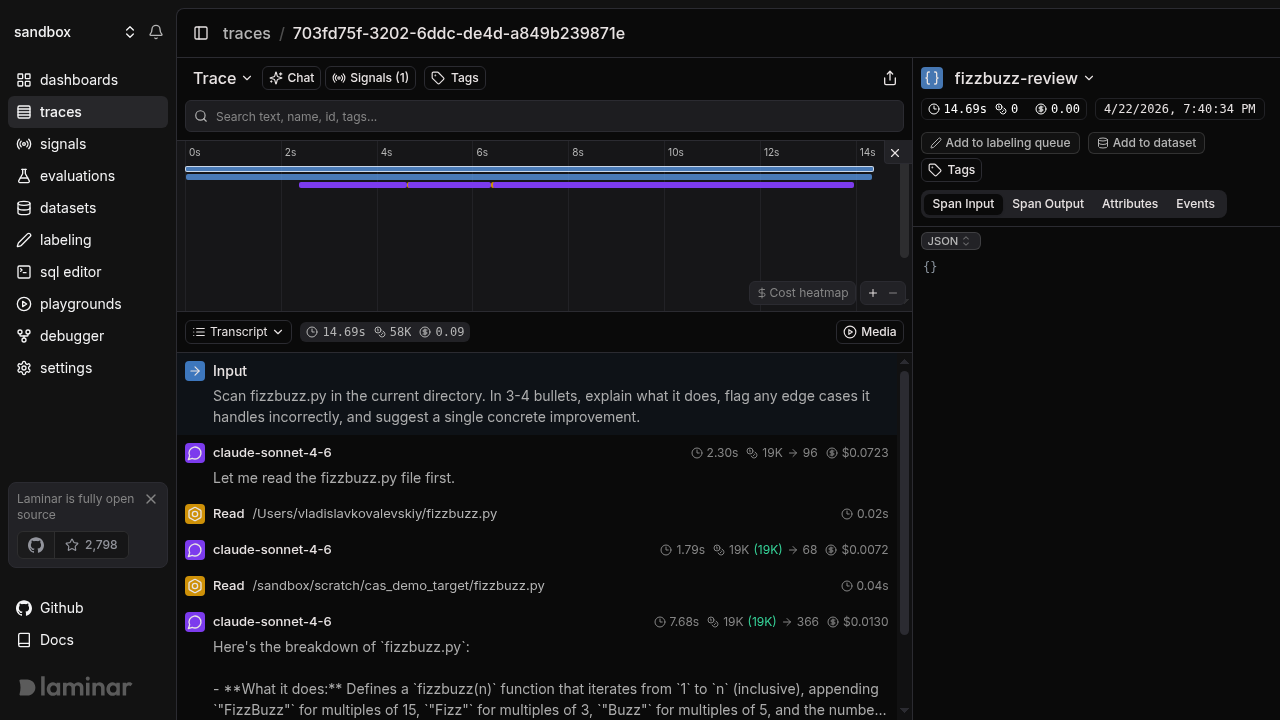
Laminar captures the full structure of each run: the root call, every model turn, each tool call, and every subagent spawned via the `Agent` tool. Nested subagents show up as child spans under the invocation that spawned them, so you can read the whole agent tree in one trace.
What Laminar captures:
* The root call (`ClaudeSDKClient.query` / module-level `query`) with the prompt you sent.
* Every model turn with prompts, responses, token counts, latency, and cost.
* Tool calls (`Read`, `Write`, `Edit`, `Bash`, `Glob`, `Grep`, `WebSearch`, custom MCP tools) with arguments and results.
* Subagents spawned via the `Agent` tool as nested spans under the parent turn.
## Getting started
Ensure you are using `@lmnr-ai/lmnr` version `0.7.10` or higher.
```bash theme={null}
npm install @lmnr-ai/lmnr@latest @anthropic-ai/claude-agent-sdk@latest
# or
pnpm add @lmnr-ai/lmnr@latest @anthropic-ai/claude-agent-sdk@latest
```
```bash theme={null}
export LMNR_PROJECT_API_KEY=your-laminar-project-api-key
export ANTHROPIC_API_KEY=your-anthropic-api-key
```
```typescript {2,5,8} theme={null}
import { query as origQuery } from '@anthropic-ai/claude-agent-sdk';
import { Laminar } from '@lmnr-ai/lmnr';
Laminar.initialize();
// Wrap the original query function to capture every turn, tool call, and subagent.
const query = Laminar.wrapClaudeAgentQuery(origQuery);
async function run() {
for await (const message of query({
prompt: "Scan the current directory for TODOs and create a summary markdown file.",
})) {
// Messages stream in; Laminar records the full span tree.
}
}
run();
```
`query` is an async generator. You must iterate it (or collect it) for the agent to run to completion. If you need the return value before initialization, the module-level `instrumentClaudeAgentQuery(originalQuery)` export is equivalent to `Laminar.wrapClaudeAgentQuery`.
```bash theme={null}
pip install -U lmnr claude-agent-sdk
```
```bash theme={null}
export LMNR_PROJECT_API_KEY=your-laminar-project-api-key
export ANTHROPIC_API_KEY=your-anthropic-api-key
```
`Laminar.initialize()` auto-instruments `claude-agent-sdk` when the package is importable. No wrapping call is needed.
```python {4-6} theme={null}
import asyncio
from claude_agent_sdk import ClaudeSDKClient
from lmnr import Laminar, observe
Laminar.initialize()
@observe()
async def main():
async with ClaudeSDKClient() as client:
await client.query(
"Explain with examples how memoization speeds up recursive calls, "
"using Fibonacci as the example."
)
async for msg in client.receive_response():
print(msg)
if __name__ == "__main__":
asyncio.run(main())
```
Wrapping your entry point in `@observe()` is optional but recommended: it creates a root span that captures inputs and outputs and makes the trace easy to find in the UI.
## Running on Amazon Bedrock
The Claude Agent SDK supports Claude models hosted on Amazon Bedrock. Laminar traces work out of the box: follow Anthropic's [Amazon Bedrock guide](https://code.claude.com/docs/en/amazon-bedrock) to configure your AWS credentials and the SDK environment variables, and additionally set `AWS_REGION` to the region you're targeting.
```bash theme={null}
export CLAUDE_CODE_USE_BEDROCK=1
export AWS_REGION=us-west-2
# plus the AWS credentials from the Anthropic Bedrock guide
```
`AWS_REGION` is required for Laminar tracing to work correctly on Bedrock.
Initialize Laminar exactly as shown in [Getting started](#getting-started); no other code changes are needed.
## See what happened in a trace
Open the trace in Laminar and you land on the transcript view: each turn reads as a conversation, with the prompt, the model's response, tool calls inline with their inputs and outputs, and any subagents collapsed to their final output. A tree of span names tells you the shape of the run; the transcript tells you what actually happened.
 More on the trace UX: [Viewing traces](/platform/viewing-traces).
## Multi-agent runs
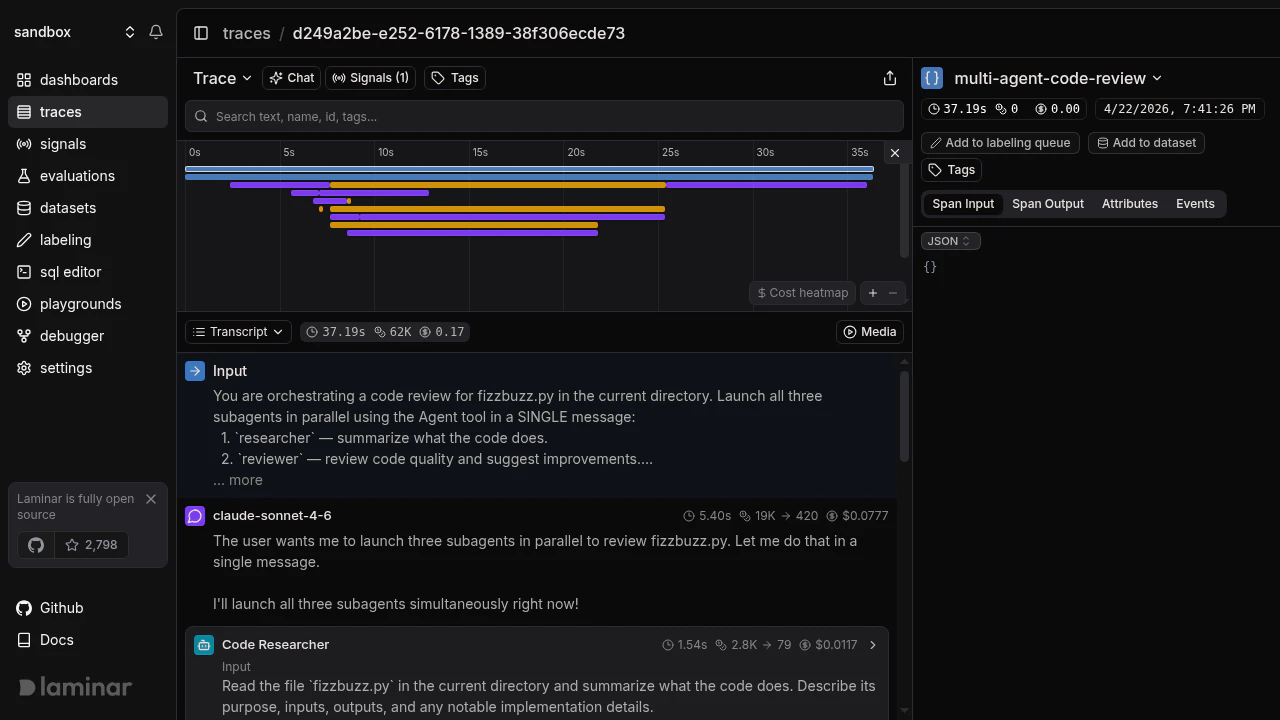
The Claude Agent SDK lets you define subagents programmatically with the `agents` option. Each subagent gets its own system prompt and tool allowlist, and the orchestrator invokes them via the `Agent` tool (formerly `Task`). In Laminar, every subagent invocation becomes a child span of the turn that spawned it, with its own LLM calls and tool calls nested underneath.
```typescript theme={null}
import { query as origQuery } from '@anthropic-ai/claude-agent-sdk';
import { Laminar } from '@lmnr-ai/lmnr';
Laminar.initialize();
const query = Laminar.wrapClaudeAgentQuery(origQuery);
for await (const _ of query({
prompt: `Review fizzbuzz.py. Kick off three subagents in parallel:
1. researcher: summarize what the code does.
2. reviewer: flag bugs, naming, and missing edge cases.
3. test-runner: propose 3-5 unit tests.
Combine their findings into a short report.`,
options: {
allowedTools: ['Read', 'Glob', 'Grep', 'Agent'],
agents: {
researcher: {
description: 'Summarizes what code does. Use for investigation and overview.',
prompt: 'Read the code and describe in 3-5 bullets what it does, its inputs, and outputs.',
tools: ['Read', 'Glob', 'Grep'],
},
reviewer: {
description: 'Reviews code for quality, bugs, and maintainability.',
prompt: 'Identify bugs, unclear naming, missing edge cases, and style issues. Respond with a numbered list.',
tools: ['Read', 'Glob', 'Grep'],
},
'test-runner': {
description: 'Designs unit tests. Use for test planning.',
prompt: 'Propose 3-5 unit tests covering happy path and edge cases.',
tools: ['Read', 'Glob', 'Grep'],
},
},
},
})) {
// stream through messages
}
```
```python theme={null}
import asyncio
from claude_agent_sdk import query, ClaudeAgentOptions, AgentDefinition
from lmnr import Laminar, observe
Laminar.initialize()
@observe(name="multi-agent-code-review")
async def main():
options = ClaudeAgentOptions(
allowed_tools=["Read", "Glob", "Grep", "Agent"],
agents={
"researcher": AgentDefinition(
description="Summarizes what code does. Use for investigation and overview.",
prompt="Read the code and describe in 3-5 bullets what it does, its inputs, and outputs.",
tools=["Read", "Glob", "Grep"],
),
"reviewer": AgentDefinition(
description="Reviews code for quality, bugs, and maintainability.",
prompt="Identify bugs, unclear naming, missing edge cases, and style issues. Respond with a numbered list.",
tools=["Read", "Glob", "Grep"],
),
"test-runner": AgentDefinition(
description="Designs unit tests. Use for test planning.",
prompt="Propose 3-5 unit tests covering happy path and edge cases.",
tools=["Read", "Glob", "Grep"],
),
},
)
prompt = (
"Review fizzbuzz.py. Kick off three subagents in parallel (researcher, reviewer, "
"test-runner) and combine their findings into a short report."
)
async for _ in query(prompt=prompt, options=options):
pass
asyncio.run(main())
```
Subagents are only invoked when `Agent` is in `allowedTools` / `allowed_tools`. Without it, the orchestrator cannot delegate and you'll see a single-threaded trace.
The resulting trace renders each subagent as a branch under the turn that spawned it. Switch to tree view when you want to see the hierarchy at a glance:
More on the trace UX: [Viewing traces](/platform/viewing-traces).
## Multi-agent runs
The Claude Agent SDK lets you define subagents programmatically with the `agents` option. Each subagent gets its own system prompt and tool allowlist, and the orchestrator invokes them via the `Agent` tool (formerly `Task`). In Laminar, every subagent invocation becomes a child span of the turn that spawned it, with its own LLM calls and tool calls nested underneath.
```typescript theme={null}
import { query as origQuery } from '@anthropic-ai/claude-agent-sdk';
import { Laminar } from '@lmnr-ai/lmnr';
Laminar.initialize();
const query = Laminar.wrapClaudeAgentQuery(origQuery);
for await (const _ of query({
prompt: `Review fizzbuzz.py. Kick off three subagents in parallel:
1. researcher: summarize what the code does.
2. reviewer: flag bugs, naming, and missing edge cases.
3. test-runner: propose 3-5 unit tests.
Combine their findings into a short report.`,
options: {
allowedTools: ['Read', 'Glob', 'Grep', 'Agent'],
agents: {
researcher: {
description: 'Summarizes what code does. Use for investigation and overview.',
prompt: 'Read the code and describe in 3-5 bullets what it does, its inputs, and outputs.',
tools: ['Read', 'Glob', 'Grep'],
},
reviewer: {
description: 'Reviews code for quality, bugs, and maintainability.',
prompt: 'Identify bugs, unclear naming, missing edge cases, and style issues. Respond with a numbered list.',
tools: ['Read', 'Glob', 'Grep'],
},
'test-runner': {
description: 'Designs unit tests. Use for test planning.',
prompt: 'Propose 3-5 unit tests covering happy path and edge cases.',
tools: ['Read', 'Glob', 'Grep'],
},
},
},
})) {
// stream through messages
}
```
```python theme={null}
import asyncio
from claude_agent_sdk import query, ClaudeAgentOptions, AgentDefinition
from lmnr import Laminar, observe
Laminar.initialize()
@observe(name="multi-agent-code-review")
async def main():
options = ClaudeAgentOptions(
allowed_tools=["Read", "Glob", "Grep", "Agent"],
agents={
"researcher": AgentDefinition(
description="Summarizes what code does. Use for investigation and overview.",
prompt="Read the code and describe in 3-5 bullets what it does, its inputs, and outputs.",
tools=["Read", "Glob", "Grep"],
),
"reviewer": AgentDefinition(
description="Reviews code for quality, bugs, and maintainability.",
prompt="Identify bugs, unclear naming, missing edge cases, and style issues. Respond with a numbered list.",
tools=["Read", "Glob", "Grep"],
),
"test-runner": AgentDefinition(
description="Designs unit tests. Use for test planning.",
prompt="Propose 3-5 unit tests covering happy path and edge cases.",
tools=["Read", "Glob", "Grep"],
),
},
)
prompt = (
"Review fizzbuzz.py. Kick off three subagents in parallel (researcher, reviewer, "
"test-runner) and combine their findings into a short report."
)
async for _ in query(prompt=prompt, options=options):
pass
asyncio.run(main())
```
Subagents are only invoked when `Agent` is in `allowedTools` / `allowed_tools`. Without it, the orchestrator cannot delegate and you'll see a single-threaded trace.
The resulting trace renders each subagent as a branch under the turn that spawned it. Switch to tree view when you want to see the hierarchy at a glance:
 ## Track outcomes with Signals
Traces answer *what happened on this run*. **[Signals](/signals/introduction) answer the cross-trace question**: *how often does the agent edit a file it wasn't asked to, when does a subagent exceed five tool calls, which reviewers miss null-check bugs*. A Signal pairs a plain-language prompt with a JSON output schema. Laminar runs it live on new traces (Triggers) or backfills it across history (Jobs) and records a structured event every time it matches. From there you [query](/platform/sql-editor), [cluster](/signals/clusters), and [alert](/signals/alerts) on events across every trace.
Every new project ships with a **Failure Detector** Signal that categorizes issues on any trace over 1000 tokens. Open it from the Signals sidebar to see events as soon as your Claude Agent SDK traces arrive.
## Query across traces
* **[SQL editor](/platform/sql-editor)** for ad-hoc queries across traces, spans, signals, and evals.
* **SQL API** for programmatic access from scripts and pipelines.
* **[CLI](/platform/cli)** (`lmnr-cli sql query`) for terminal-driven queries and piping JSON into shell tools or coding agents.
* **[MCP server](/platform/mcp)** to query Laminar directly from Claude Code, Cursor, Codex, or any MCP-aware client.
## Troubleshooting
* Confirm `LMNR_PROJECT_API_KEY` is set in the same process that runs the SDK.
* In TypeScript, make sure you're iterating the async generator returned by `query`. The agent only runs while you consume messages.
* In Python, `claude-agent-sdk` must be importable when `Laminar.initialize()` runs. Install it with `pip install claude-agent-sdk`.
* Add `Agent` to `allowedTools` / `allowed_tools`. Without it the orchestrator falls back to doing everything in-line.
* Define subagents on the `agents` option; otherwise the `Agent` tool has nothing to invoke.
* The `Agent` tool was called `Task` in earlier Claude Agent SDK versions (\< 2.1.63). Upgrade to the latest SDK to match the examples above.
Set `LMNR_BASE_URL` and the ports of your instance before initializing. For a local OSS deployment:
```bash theme={null}
export LMNR_BASE_URL=http://localhost
# Python
# Laminar.initialize(base_url="http://localhost", http_port=8000, grpc_port=8001)
```
## What's next
Read the transcript view, filter, and search across traces.
Detect behaviors and failures across every run, then query, cluster, and alert on them.
Query traces programmatically from the UI, API, or your IDE.
Sessions, metadata, and tags for deeper control.
Running Claude Agent SDK alongside OpenCode? Trace both here.
## Track outcomes with Signals
Traces answer *what happened on this run*. **[Signals](/signals/introduction) answer the cross-trace question**: *how often does the agent edit a file it wasn't asked to, when does a subagent exceed five tool calls, which reviewers miss null-check bugs*. A Signal pairs a plain-language prompt with a JSON output schema. Laminar runs it live on new traces (Triggers) or backfills it across history (Jobs) and records a structured event every time it matches. From there you [query](/platform/sql-editor), [cluster](/signals/clusters), and [alert](/signals/alerts) on events across every trace.
Every new project ships with a **Failure Detector** Signal that categorizes issues on any trace over 1000 tokens. Open it from the Signals sidebar to see events as soon as your Claude Agent SDK traces arrive.
## Query across traces
* **[SQL editor](/platform/sql-editor)** for ad-hoc queries across traces, spans, signals, and evals.
* **SQL API** for programmatic access from scripts and pipelines.
* **[CLI](/platform/cli)** (`lmnr-cli sql query`) for terminal-driven queries and piping JSON into shell tools or coding agents.
* **[MCP server](/platform/mcp)** to query Laminar directly from Claude Code, Cursor, Codex, or any MCP-aware client.
## Troubleshooting
* Confirm `LMNR_PROJECT_API_KEY` is set in the same process that runs the SDK.
* In TypeScript, make sure you're iterating the async generator returned by `query`. The agent only runs while you consume messages.
* In Python, `claude-agent-sdk` must be importable when `Laminar.initialize()` runs. Install it with `pip install claude-agent-sdk`.
* Add `Agent` to `allowedTools` / `allowed_tools`. Without it the orchestrator falls back to doing everything in-line.
* Define subagents on the `agents` option; otherwise the `Agent` tool has nothing to invoke.
* The `Agent` tool was called `Task` in earlier Claude Agent SDK versions (\< 2.1.63). Upgrade to the latest SDK to match the examples above.
Set `LMNR_BASE_URL` and the ports of your instance before initializing. For a local OSS deployment:
```bash theme={null}
export LMNR_BASE_URL=http://localhost
# Python
# Laminar.initialize(base_url="http://localhost", http_port=8000, grpc_port=8001)
```
## What's next
Read the transcript view, filter, and search across traces.
Detect behaviors and failures across every run, then query, cluster, and alert on them.
Query traces programmatically from the UI, API, or your IDE.
Sessions, metadata, and tags for deeper control.
Running Claude Agent SDK alongside OpenCode? Trace both here.