
Braintrust is an eval-first AI platform. It shines at regression testing: write a scorer, run a suite across prompts and models, catch the diff before the PR merges. For teams whose bottleneck is "did this change break behavior X," it is a strong tool.
The trouble starts when eval regression is not the bottleneck. An agent can run for hours, call fifteen tools, spawn sub-agents, and fail in subtle, unexpected ways. Braintrust shows you the trace, but the UX is built for scoring, not for reading what the agent did and finding where it went wrong. That is a different product.
This article ranks the top Braintrust alternatives for 2026, ordered by how well they handle agents rather than eval-first regression testing. TLDR: the best Braintrust alternative in 2026 is Laminar, because Laminar was built for AI agents from the ground up.
Best Braintrust alternatives in 2026
| Tool / Platform | License / Source | Key Features & Architecture | Best Used For |
|---|---|---|---|
| Laminar | Open-source (Apache 2.0) | OpenTelemetry-native, built for AI agents, 20x trace compression, lowest pricing on market, Signals, Agent Debugger, raw SQL over platform data, code-first eval SDK. | Best Braintrust alternative if you are shipping agents and looking for an OSS solution |
| Langfuse | Open-source (MIT) | Prompt-first architecture, prompt management, typed observations. | Best Braintrust alternative if you want OSS evals with prompt management. |
| Arize Phoenix | Open-source (Elastic 2.0) | OpenTelemetry-native via OpenInference. | Best Braintrust alternative for notebook and eval-heavy research workflows. |
| LangSmith | Closed source | LangChain-first architecture. | Best Braintrust alternative if you are locked into the LangGraph stack. |
| Weights & Biases Weave | Closed source | Deep integration with W&B ecosystem. | Best Braintrust alternative for ML teams already living in W&B. |
| Helicone | Open-source | Proxy logging. | Best Braintrust alternative for quick request/response capture on raw LLM calls. |
| Traceloop / OpenLLMetry | Vendor-neutral | OpenTelemetry instrumentation. | Best Braintrust alternative when portability of instrumentation matters more than the backend. |
Why Laminar is the best Braintrust alternative
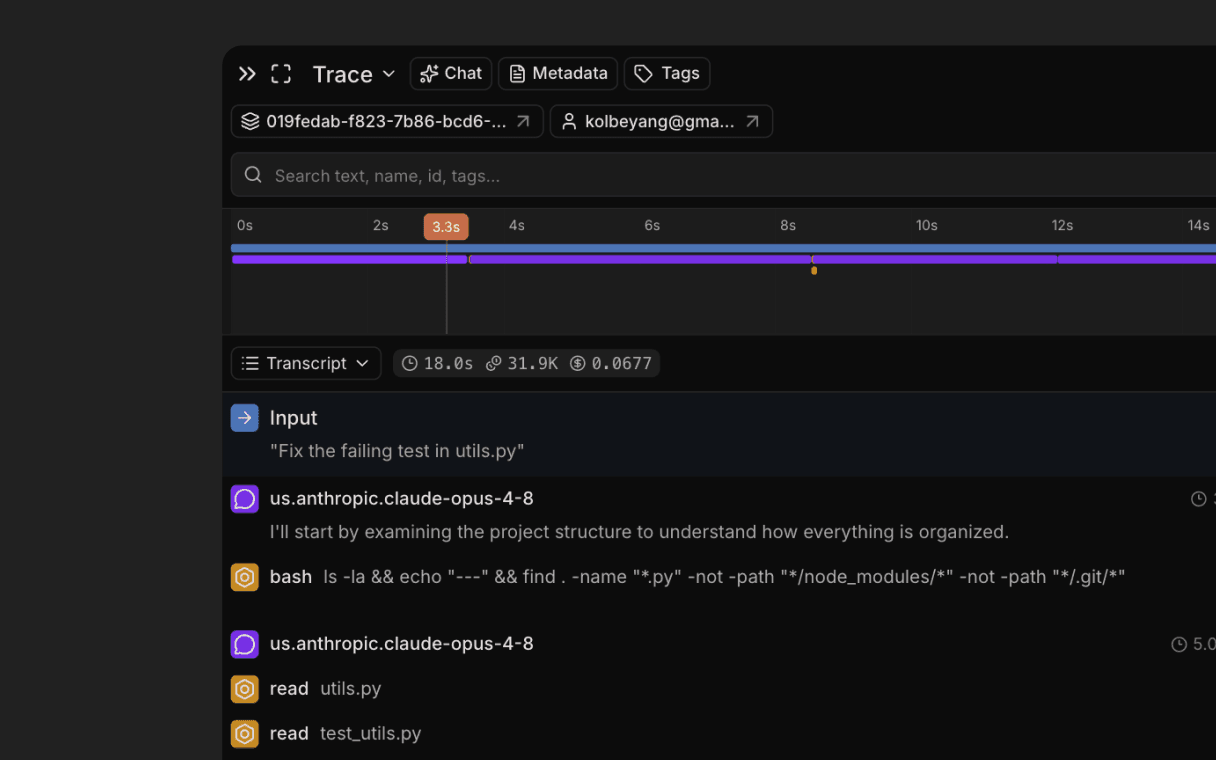
Laminar is an open-source, OpenTelemetry-native observability platform purpose-built for AI agents. Where Braintrust organizes around eval suites and scorers, Laminar organizes around the agent: how its traces are shaped and stored, how you read them, and how you understand agent failure modes and fix them.
Open-source and easy to self-host
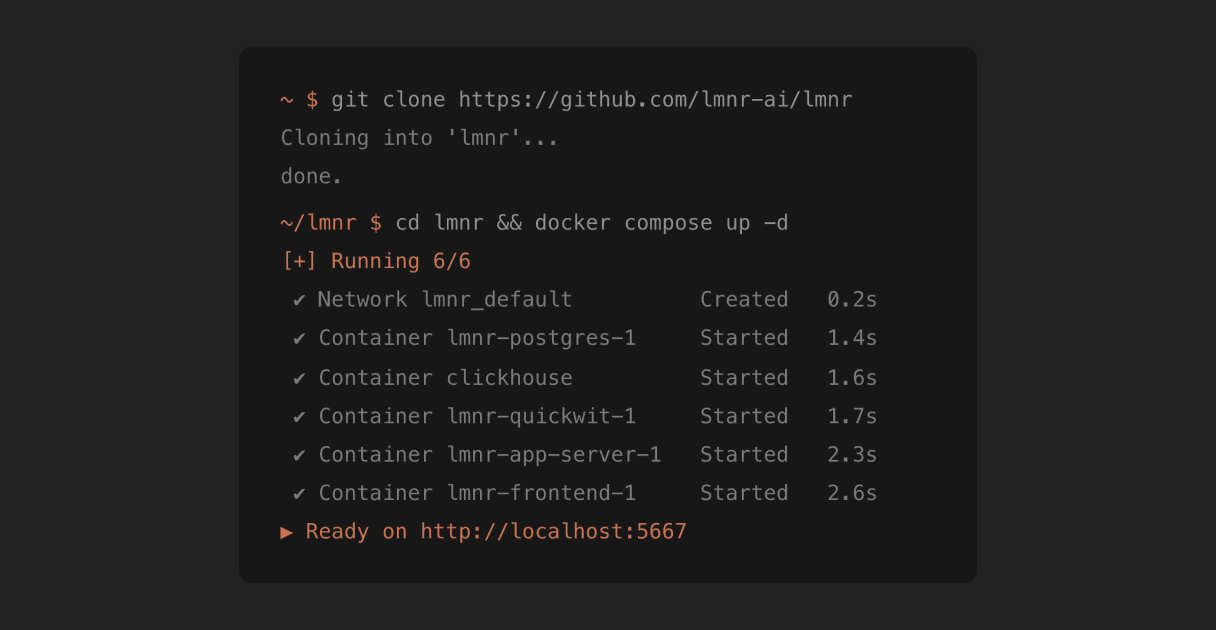
Laminar is Apache 2.0 and can be easily self-hosted with Docker Compose with a single command or with a production-ready Helm chart for high scale applications. Every feature ships on the OSS image, including Signals, the SQL editor, and the debugger. Braintrust is closed source, its Brainstore storage layer is proprietary, and self-host is gated behind an Enterprise contract.
20x trace compression and the best data pricing on the market
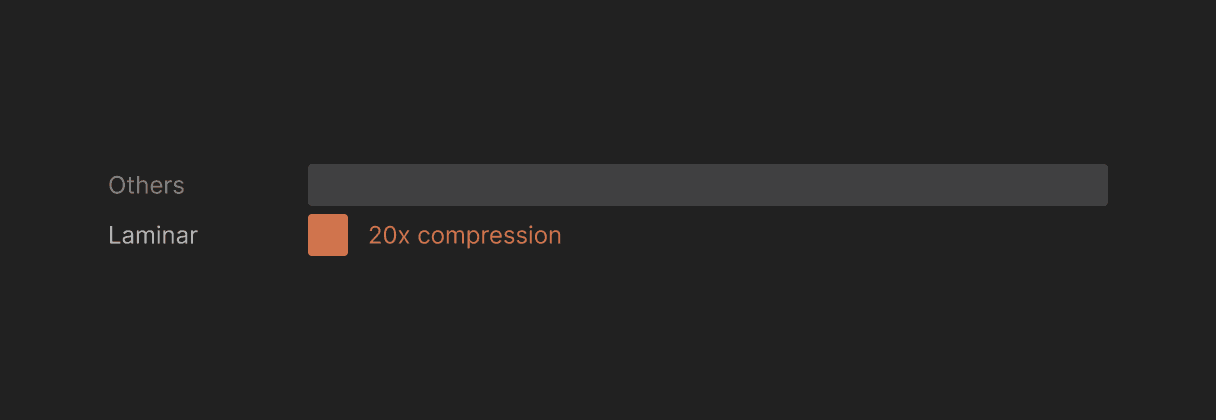
Agents re-send the whole conversation every turn, so Laminar stores each unique message once and reconstructs traces on read. This results in 20x less storage on average, and up to 50x on long runs. We go into the details of trace compression in this blog post.
That's why our data pricing is the lowest on the market, twice over. You pay per GB of unique data, not for the copies your agent re-sends on every turn. And the per-GB rate itself is lower, because the storage layer costs us less to run. Laminar Pro is $150/month for 10GB at 6-month retention with unlimited seats; Braintrust Pro is $249/month for 5GB and 50k scores at 30-day retention.
Start on a generous free tier and scale without a surprise bill. See the pricing page.
Signals: track agent failures in plain language
A Signal is a prompt that runs against every trace. "Agent used tools inefficiently." "User asked for the same thing twice." "Tool failed and the agent made up the data instead." Laminar's agent analyzes every trace, and when it finds what you described it produces a structured event: queryable via SQL, clustered with similar events from other runs, and backfilled across your history. You can also connect Slack and receive a realtime alert when a certain event is detected.
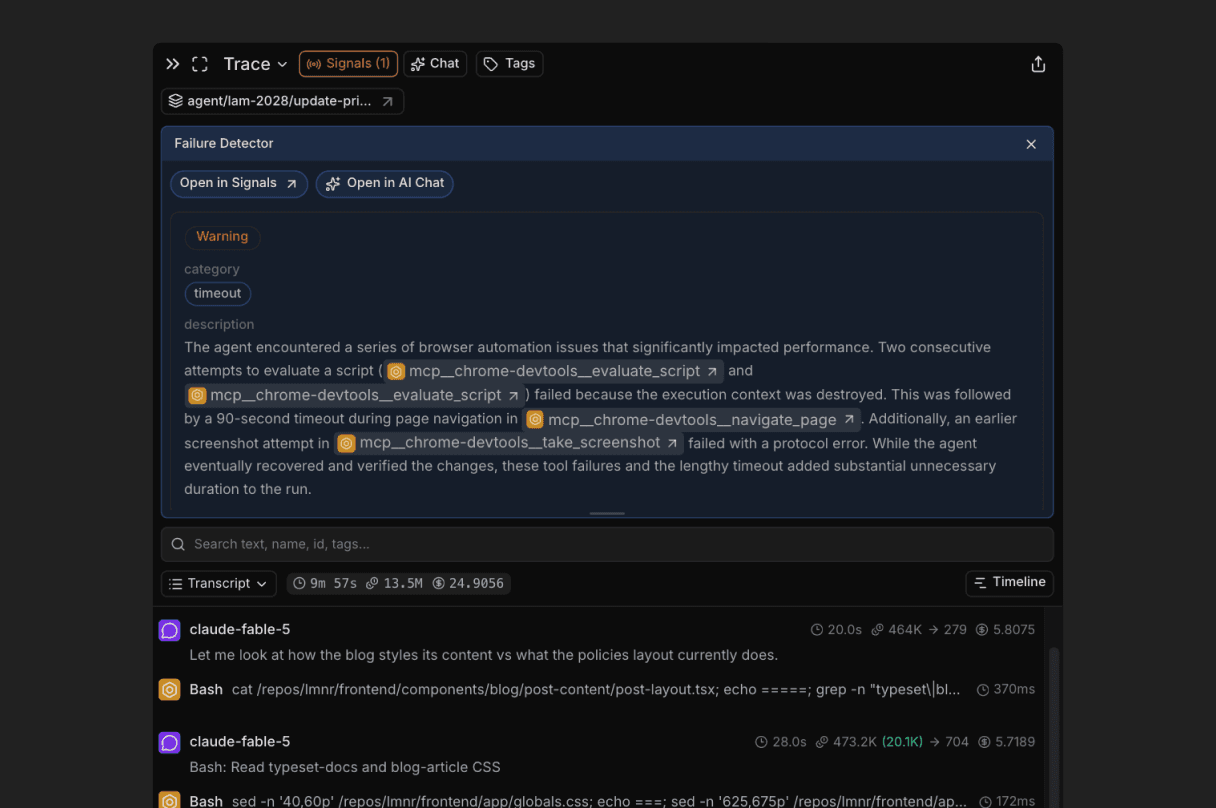
A Signal reads the whole trace, every LLM turn and tool call from first span to last, because most agent failures only make sense in the context of the entire agent run.
Then we go one step further. Laminar runs a proprietary online clustering algorithm over all extracted signal events, so instead of scrolling ten thousand individual events you see the ten behaviors your agent actually has. Clusters are a high-level map of your agent in production: what fails, how often, and which failures are the same failure.
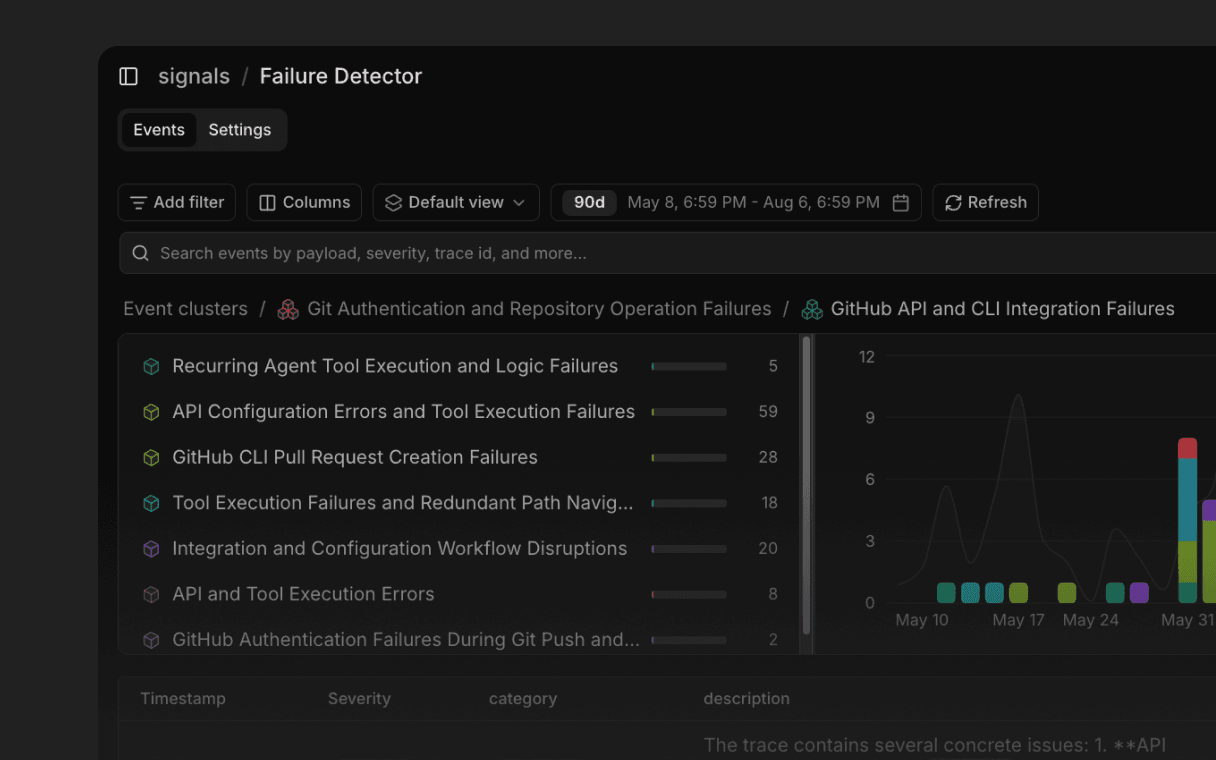
Braintrust scorers run against a dataset; a Signal runs against production, backfills across history, and keeps firing on new traces without re-tagging anything.
Evals: a code-first, barebones SDK
Evals are the one place Braintrust is genuinely strong, and Laminar competes on its own terms. Laminar's evaluations follow a code-first philosophy: a small, unopinionated SDK that makes versatile evals easy to write, because agent behavior is too varied for a rigid eval form. You define datapoints, an executor function that produces an output, and one or more evaluator functions that score it. Laminar runs them in parallel, traces every call, and stores the scores so you can compare runs over time.
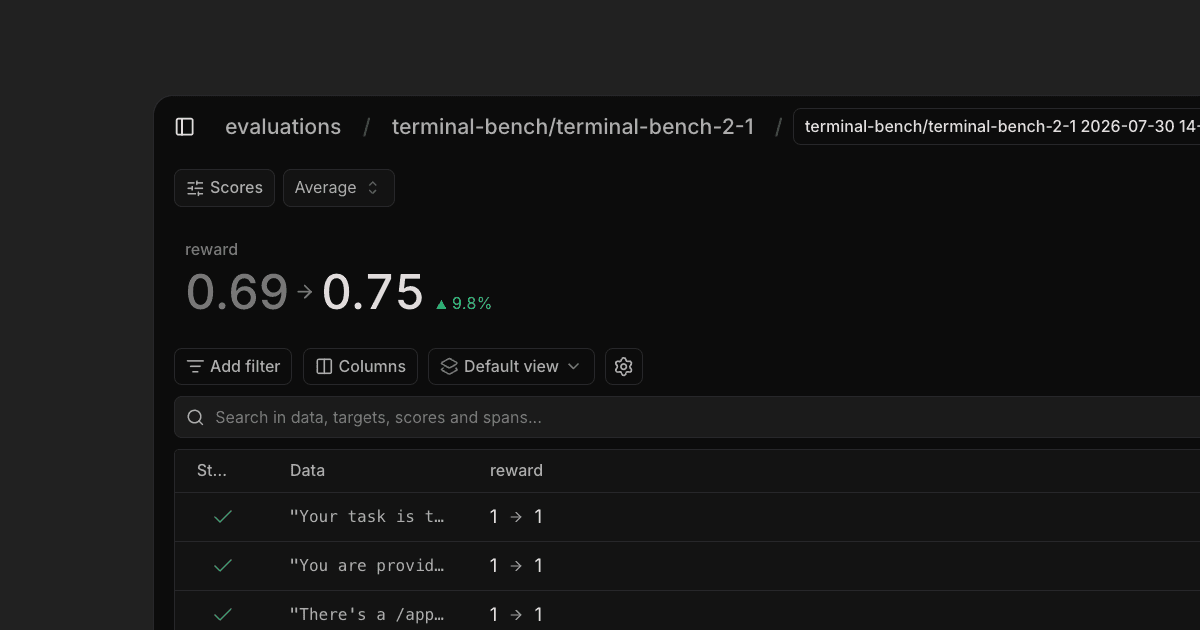
Your coding agent can use Laminar to improve your agent
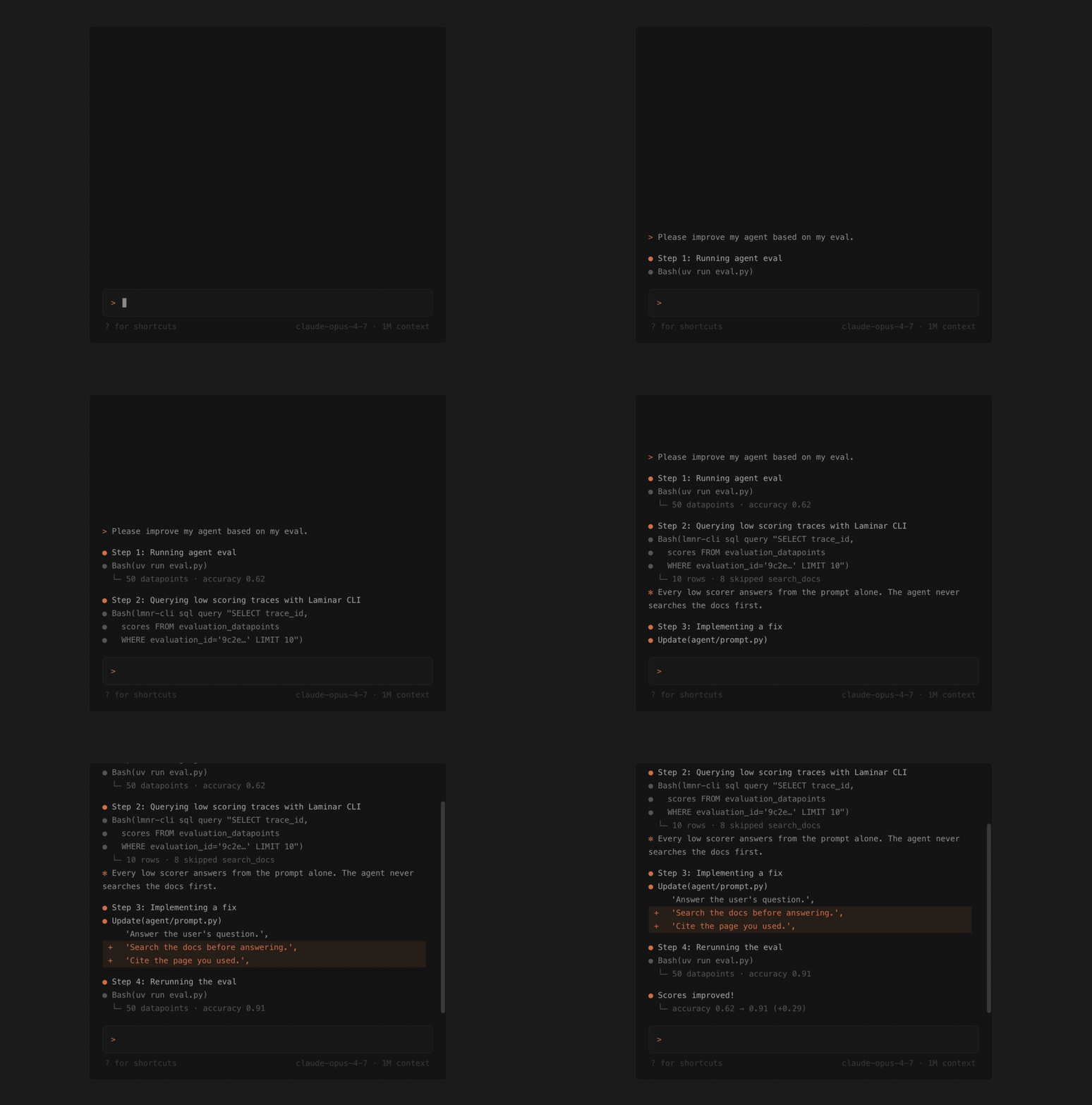
Building an agent is a loop: run it, read what it did, change something, run it again. Laminar is built so a coding agent can drive that loop, because all platform data, traces, spans, signal events, and eval scores, is exposed through raw SQL. Your coding agent queries it from the CLI (lmnr-cli sql query) or the MCP server, and you get the same SQL in the UI and API.
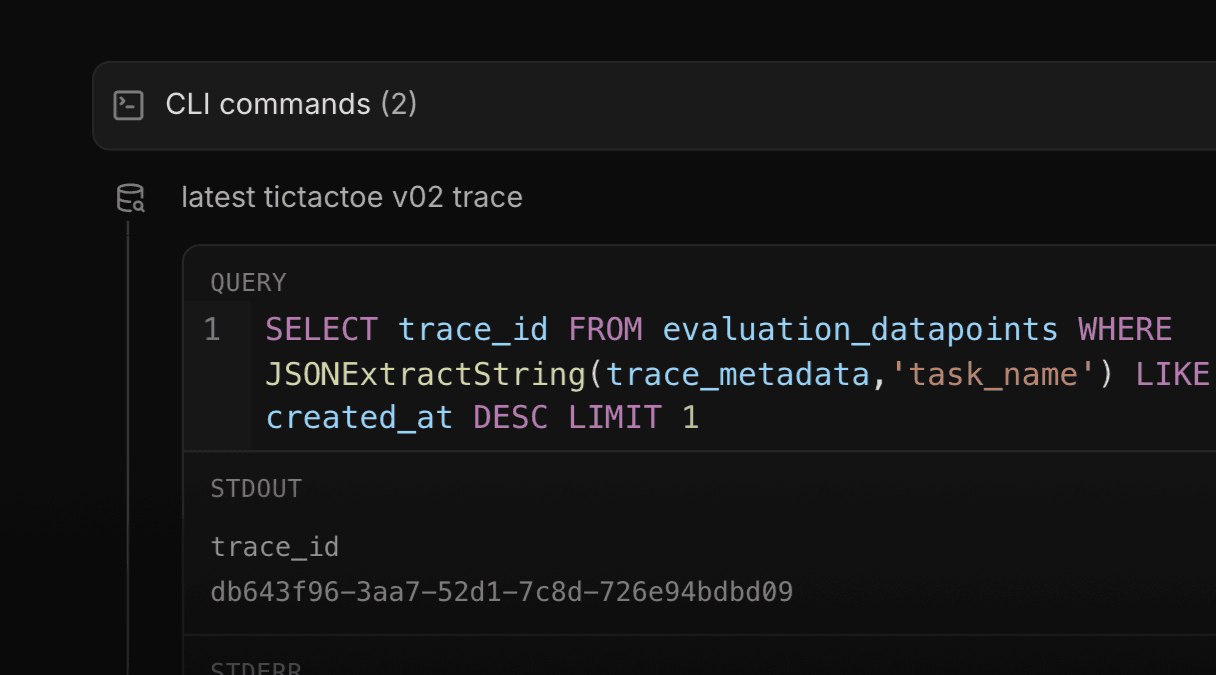
The loop it runs: query the worst failures, read the traces, fix the code, rerun, measure against the same eval. The debugger captures every trace, eval, CLI command, and note in one session, and replays cached responses on reruns so each iteration is cheap.
Where Laminar is not the right pick
- Your entire workflow is CI-driven eval regression with scorer sweeps across prompts and models. Braintrust is still strongest in that narrow lane.
- You have no tool use, no sub-agents, and no multi-step runs. A single-call logging tool is enough.
2. Langfuse
License: MIT. Deployment: Cloud, self-host. Repo: github.com/langfuse/langfuse.
If you like Braintrust's model but need a permissive OSS license, Langfuse is the closest swap. Prompt versioning, typed observations (generations, spans, events), an eval harness with LLM-as-judge and custom scorers, and a self-host that includes every feature on the free image.
Strengths:
- MIT license. Fully open source, free self-host with all features.
- Strong prompt management: versioning, tagging, release channels.
- Eval harness with scorers, human feedback, and CI integration.
Weaknesses:
- Observation-first data model. Long agent runs render as a list of observations rather than a transcript.
- Unit-based Cloud pricing (traces + observations + scores) adds up on agent workloads.
- No raw SQL over traces in product, no natural-language outcome tracking, no trace compression.
Pricing: Free tier includes 50k observations with 30-day retention. Core $29/month. Pro $199/month. Self-host is free with all features. See the full Langfuse comparison.
3. Arize Phoenix
License: Elastic License 2.0. Deployment: Self-host (pip install or Helm), Arize AX managed option.
Phoenix is the open-source side of Arize. It ships OpenInference, the most widely adopted OTel semantic conventions for LLM spans, and a strong eval harness.
Strengths:
- OpenTelemetry-native via OpenInference. Instrument once, send anywhere.
- Phoenix Evals: mature library of LLM-as-judge templates.
- Notebook-friendly; runs in Colab or locally.
Weaknesses:
- Span-tree-first trace UX. No transcript view.
- Elastic License 2.0 is not OSI-approved open source. ELv2 prohibits offering Phoenix as a hosted service to third parties. For teams whose legal team uses the OSI definition, this is a blocker.
- Graduation path to Arize AX is a separate contract with span-based pricing.
Pricing: Phoenix OSS is free. Arize AX: Free tier 25k spans + 1GB, Pro $50/month for 50k spans + 10GB. Full comparison: Arize Phoenix alternatives 2026.
4. LangSmith
License: Closed source. Deployment: Cloud, hybrid, self-hosted (Enterprise only).
LangSmith is LangChain's managed platform. Strong eval harness, and LangGraph Studio is the best agent IDE available if your stack is LangGraph.
Strengths:
- LangGraph Studio (real agent IDE, not just a viewer).
- Mature eval harness and dataset experiments.
- OpenTelemetry support added in March 2026.
Weaknesses:
- Closed source. Self-hosting is Enterprise-only.
- Seat-based pricing ($39/seat/month on Plus) gets expensive with larger teams.
- Tightest fit is still LangChain. Teams on other frameworks get less value.
Pricing: Developer free with 5k base traces/month. Plus $39/seat/month plus $0.50 per 1k base traces.
5. Weights & Biases Weave
License: Closed source. Deployment: Cloud, on-prem for Enterprise.
Weave plugs tracing and evals into the existing W&B console. If your team already evaluates models there, agents get the same tooling.
Strengths:
- Native W&B integration.
- Strong eval framework with scorers and comparisons.
- Good for teams evaluating models and agents on the same platform.
Weaknesses:
- Trace UX borrowed from ML experiment tracking. Not agent-first.
- Weak on realtime trace viewing during long runs.
- Closed source.
Pricing: Free tier with limited storage. Paid plans scale with volume and seats.
6. Helicone
License: Apache 2.0. Deployment: Cloud, self-host.
Helicone is a proxy that sits in front of the LLM provider and logs every request. Simplest integration of any tool in this list: change a base URL. Lightweight eval hooks, but not a replacement for Braintrust's scorer harness.
Strengths:
- Zero-code proxy integration.
- Caching, rate-limit handling, and retries built into the proxy.
- Cheap to get started.
Weaknesses:
- Request/response focused, not span-based. Multi-step agents are stitched together after the fact.
- Eval tooling is light compared to Braintrust, Phoenix, or Langfuse.
- Proxy model adds a hop to every LLM call.
Pricing: Free tier. Paid plans scale with request volume.
7. Traceloop / OpenLLMetry
License: Apache 2.0 (OpenLLMetry SDK). Deployment: Cloud backend, vendor-neutral SDK.
Traceloop's value is the OpenLLMetry SDK: vendor-neutral OpenTelemetry instrumentation for LLMs. Traceloop's own backend is one place the traces can go. Most backends in this list (Laminar, Langfuse, Phoenix, LangSmith) can also ingest OpenLLMetry spans, which makes OpenLLMetry the safest instrumentation choice for teams that want portability.
Strengths:
- OTel-native. Works with any compatible backend.
- Active open-source community.
Weaknesses:
- The backend UX is less agent-specific than Laminar or LangSmith.
- Primary value is the SDK, not the product.
Head-to-head: where each Braintrust alternative wins
| Criterion | Winner | Why |
|---|---|---|
| Agent-specific trace UX | Laminar | Transcript view, 20x compression, Signals, coding-agent debugger. |
| Trace storage efficiency | Laminar | 20x average compression on agent traces, up to 50x on the longest runs. |
| Eval SDK | Laminar / Braintrust | Code-first, versatile evals on both; Braintrust adds CI scorer sweeps. |
| Permissive OSS license | Laminar / Langfuse / Helicone | Apache 2.0 or MIT. No ELv2 restrictions, no Enterprise gate on self-host. |
| OpenTelemetry support | Laminar / Phoenix | Both OTel-native from day one. |
| LangGraph integration | LangSmith | LangGraph Studio is the best agent IDE today. |
| Vendor-neutral instrumentation | OpenLLMetry / OpenInference | Instrument once, switch backends later. |
| Pricing predictability | Laminar | Data-volume pricing on compressed traces, no seat or score-unit fees. |
Pricing comparison for 2026
| Platform | Free tier | Paid entry | Enterprise / self-host |
|---|---|---|---|
| Laminar | 1GB, 7-day retention | $30/mo Hobby (3GB, 30-day), $150/mo Pro (10GB, 6-month retention) | Custom. Self-host free via Helm chart, all features included |
| Braintrust | 1GB + 10k scores, 14-day retention | $249/mo Pro (5GB + 50k scores, 30-day retention) | Custom. Self-host Enterprise-only (hybrid deployment) |
| Langfuse | 50k observations, 30-day retention | $29/mo Core, $199/mo Pro | $2,499/mo Enterprise, self-host all features |
| Phoenix / Arize AX | Phoenix OSS free; AX Free 25k spans | AX Pro $50/mo (50k spans, 10GB) | AX Enterprise custom |
| LangSmith | 5k base traces | $39/seat/mo + $0.50 per 1k traces | Enterprise self-host |
| Weave | Limited storage | Scales with volume and seats | On-prem for Enterprise |
| Helicone | Free tier | Scales with requests | Self-host |
Braintrust's $249/month entry price for Pro is the highest paid-entry price in this list. Laminar's $150/month Pro buys more data (10GB vs 5GB) at longer retention (6 months vs 30 days), and because Laminar compresses agent traces ~20x, that 10GB holds far more real agent traffic than the raw number suggests.
Open-source scorecard
| Platform | License | Self-host | All features on self-host | OSI-approved |
|---|---|---|---|---|
| Laminar | Apache 2.0 | Yes, Helm chart, one command | Yes | Yes |
| Langfuse | MIT | Yes | Yes | Yes |
| Phoenix | Elastic License 2.0 | Yes | Yes | No |
| Helicone | Apache 2.0 | Yes | Yes | Yes |
| OpenLLMetry SDK | Apache 2.0 | N/A (SDK) | N/A | Yes |
| Braintrust | Closed | Enterprise-only hybrid | N/A | N/A |
| LangSmith | Closed | Enterprise only | N/A | N/A |
| Weave | Closed | On-prem Enterprise | N/A | N/A |
The line that matters for Braintrust alternatives: if OSS self-host is a requirement, Braintrust is out, and Laminar, Langfuse, Phoenix, and Helicone are your options. Of those, Laminar is Apache 2.0 (OSI) and ships every feature on the free self-host image.
How to pick a Braintrust alternative in 5 minutes
Answer these in order. Stop at the first yes.
- Are you shipping and debugging AI agents and want a transcript view, 20x compression, Signals, SQL, and a coding-agent debugger? → Laminar.
- Do you want OSS evals with strong prompt management? → Langfuse.
- Are you already on Arize or need OpenInference compatibility? → Phoenix.
- Are you committed to LangChain or LangGraph and want an agent IDE? → LangSmith.
- Does your ML team live in W&B? → Weave.
- Do you just need cheap request/response logs? → Helicone.
- Do you want vendor-neutral instrumentation and will decide the backend later? → OpenLLMetry plus any of the above.
Migrating from Braintrust to Laminar
Straightforward because both products speak OpenTelemetry.
- Switch the exporter. Braintrust's TypeScript and Python SDKs are OTel-based. Point the OTLP exporter at Laminar's endpoint and traces land. If you prefer Laminar's native SDK, Python and TypeScript both follow the same auto-instrumentation pattern. Start with the Laminar quickstart.
- Recreate production outcomes as Signals. Keep offline Braintrust evals running if they are wired into CI. For production outcome tracking, recreate the important scorers as Signals so they backfill across history and fire on new traces going forward.
- Port the evals you want in code. Laminar's eval SDK is code-first; port the scorers that matter as evaluator functions and run them with python my_eval.py or lmnr eval.
- Run side-by-side during the transition. OTel supports multiple exporters. Send to both backends until you trust the new pipeline, then turn off the old one.
Why we still recommend Laminar
We built Laminar because no eval-first tool solved our own problem: debugging a 30-minute browser agent that failed at minute 18, with no idea which of 2,000 spans to look at first, and paying to store the same conversation re-sent on every one of those spans.
The transcript view was the first thing we built, then 20x compression so storing agent traffic stopped being the expensive part, then Signals because the failure mode you care about today is not the one your scorers captured a month ago, then the debugger so the coding agent writing your agent could run the fix loop itself. Every one of those came from understanding agents, which is the thing eval-first tools were not built around.
If you are looking at Braintrust alternatives because your workload is less about CI regression and more about shipping agents and figuring out what is going wrong in production, that is the reason to try Laminar first.
Start with the free tier: 1GB of traces, 7-day retention. Instrument one agent. If you do not see the difference in the first hour, come back and tell us why.
Try Laminar free · Read the docs · Star on GitHub
FAQ: Braintrust alternatives in 2026
What is the best Braintrust alternative in 2026?
The best Braintrust alternative in 2026 is Laminar. It is Apache 2.0 licensed, OpenTelemetry-native, and built specifically for AI agents, with 20x trace compression, the lowest pricing on the market, Signals for natural-language outcome tracking, a coding-agent-driven debugger, raw SQL over all platform data, and a code-first eval SDK. Langfuse is the best alternative if you want an OSS eval harness with prompt management; Phoenix is the best alternative if you want OpenInference compatibility; LangSmith is the best alternative for LangGraph-committed teams.
What is the best open-source Braintrust alternative?
Laminar is the best open-source Braintrust alternative. It is Apache 2.0 (OSI-approved), self-hosts in one command via an official Helm chart, and ships every feature on the free image, including Signals, the SQL editor, the debugger, and evals. Braintrust itself is closed source with Enterprise-only self-host. Langfuse (MIT) and Helicone (Apache 2.0) are the other permissive-license options.
What is the cheapest Braintrust alternative for AI agents?
Laminar is the cheapest Braintrust alternative for agent workloads. It bills on data volume with no seat fees and no per-score unit counting, and it compresses agent traces ~20x before storing them, so the same dollar covers far more real traffic. Free is 1GB at 7-day retention, Hobby is $30/month for 3GB, and Pro is $150/month for 10GB at 6-month retention with unlimited seats, versus Braintrust Pro at $249/month for 5GB plus 50k scores.
Is Braintrust open source?
No. Braintrust is a closed-source commercial SaaS, and its Brainstore storage layer is proprietary. Self-hosting requires an Enterprise "hybrid deployment" contract. The AI proxy they publish on GitHub is open source, but the platform itself is not. If you need OSS self-host, Laminar (Apache 2.0), Langfuse (MIT), and Helicone (Apache 2.0) are the options.
Does Laminar have a good eval SDK like Braintrust?
Yes. Laminar ships a code-first eval SDK: you define a dataset, an executor function, and evaluator functions in plain Python or TypeScript and run them with python my_eval.py, tsx my-eval.ts, or lmnr eval. Every run produces structured EVALUATION, EXECUTOR, and EVALUATOR spans you can query in SQL next to production traces. Braintrust is still strongest at CI-driven scorer sweeps across prompts and models; for most teams, Laminar's code-first SDK plus Signals for production outcomes covers the eval need.
Can I query Braintrust alternative trace data with SQL?
Laminar exposes raw SQL over all platform data: traces, spans, signal events, evaluations, and metadata. You can query it from the in-app SQL editor, the lmnr-cli sql query command, an MCP server (so your coding agent can query it), or the SQL API. Braintrust analysis is notebook or API-driven; there is no in-product SQL over traces.
What is the difference between Braintrust and Laminar?
Braintrust is eval-first: scorers, datasets, CI regression, prompt comparisons. Laminar is agent-first: transcript view, 20x trace compression, Signals, a coding-agent debugger, SQL over all platform data, and a code-first eval SDK. Both ingest OpenTelemetry. Licenses differ: Braintrust is closed-source SaaS with proprietary Brainstore storage, Laminar is Apache 2.0 with free Helm chart self-host. Pricing differs: Braintrust Pro is $249/month for 5GB + 50k scores; Laminar Pro is $150/month for 10GB at 6-month retention.
How does Laminar pricing compare to Braintrust?
Braintrust Starter is free with 1GB and 10k scores at 14-day retention; Pro is $249/month for 5GB and 50k scores at 30-day retention. Laminar Free is 1GB at 7-day retention; Hobby is $30/month for 3GB at 30-day retention; Pro is $150/month for 10GB at 6-month retention, unlimited seats. Laminar bills on data volume only and compresses agent traces ~20x; Braintrust bills on data plus score count. For agent workloads with many per-span outcomes, Laminar is more predictable and lower cost.
What is agent observability?
Agent observability is the practice of capturing and debugging the full execution of an AI agent, including every LLM call, tool call, retrieval, and sub-agent invocation. It differs from classical LLM observability because agent runs are long, non-deterministic, deeply nested, and re-send their full conversation on every turn. Agent-specific tooling renders the run as a transcript, compresses the repeated context, supports natural-language outcome tracking, and lets a coding agent re-run the agent from any point. See our explainer on agent observability for the longer version.
Can I keep Braintrust for CI evals and use Laminar for production observability?
Yes, and several teams do. OpenTelemetry supports multiple exporters. You can instrument once, send traces to Laminar for production debugging, and keep Braintrust wired into CI for regression testing. Over time, Laminar Signals often replace the production-facing subset of Braintrust scorers because they backfill across history and fire on new traces automatically, and Laminar's code-first eval SDK can absorb the rest.
Last updated: August 2026. Verify features and pricing against each vendor's current documentation before committing.