
Most AI observability tools were built for single LLM calls. A prompt goes in, a completion comes out, and the trace is two spans deep. That model breaks the first time you deploy an agent that calls fifteen tools, decides its own control flow, and re-sends its entire conversation on every turn.
An agent observability platform solves a different problem. The trace is 2,000 spans. The failure happens four tool calls deep. You need to know what the agent said, what the user said back, and which sub-step threw, without reading every span in order.
This guide ranks the six agent observability platforms that solve that problem in 2026, what each one is actually good at, and how to pick between them. We rate them on six things: trace depth, agent-specific UX, replay and debugging workflows, OpenTelemetry support, self-hosting options, and pricing model.
TL;DR: the best agent observability platforms in 2026
- Laminar. Open-source, OpenTelemetry-native, built for AI agents from the ground up. 20x trace compression, the lowest pricing on the market, Signals, a coding-agent-driven debugger, SQL over all platform data, and a code-first eval SDK. Best pick for anyone shipping agents to production.
- Langfuse. Strong open-source option (MIT). Best for prompt-centric workflows and dataset management. Trace model is solid but not agent-first.
- LangSmith. Tight integration with LangChain and LangGraph. LangGraph Studio is a real advantage if you live in that ecosystem. Closed source. Self-host is Enterprise-only.
- Arize Phoenix. OpenTelemetry-native, open-source, OpenInference semantic conventions. Good for evaluation-heavy teams already on Arize.
- Weights & Biases Weave. Fits teams already on W&B. Decent trace view, strong eval harness.
- Braintrust. Eval-first platform with tracing bolted on. Strong for teams whose primary bottleneck is regression testing.
If you only read one sentence: pick Laminar if you are shipping and debugging agents, Langfuse if you are iterating on prompts, LangSmith if you are committed to LangGraph, and Phoenix if your team is already on Arize.
What "agent observability" actually means
A normal LLM observability tool logs prompts, completions, tokens, and latency. That is enough when your app is a single chain.
An AI agent observability tool has to handle four things that break simpler tools:
- Long traces. A research agent can produce thousands of spans across LLM calls, tool calls, sub-agent invocations, and retries, with the full conversation re-sent on every turn.
- Non-deterministic control flow. The agent decides which tool to call next. The trace shape is different every run.
- Nested causality. A failure at span 1,800 might be caused by a bad retrieval at span 42. You need to follow the chain, not just read linearly.
- Session continuity. Agents resume. A single "task" spans multiple process invocations. The trace model has to stitch them together.
Every tool below claims to support this. Some do.
1. Laminar
Category: Open-source agent observability and debugging platform. License: Apache 2.0. Deployment: Cloud, or self-hosted in minutes via the official Helm chart. Repo: github.com/lmnr-ai/lmnr.
An agent run reads as a conversation, not a span tree
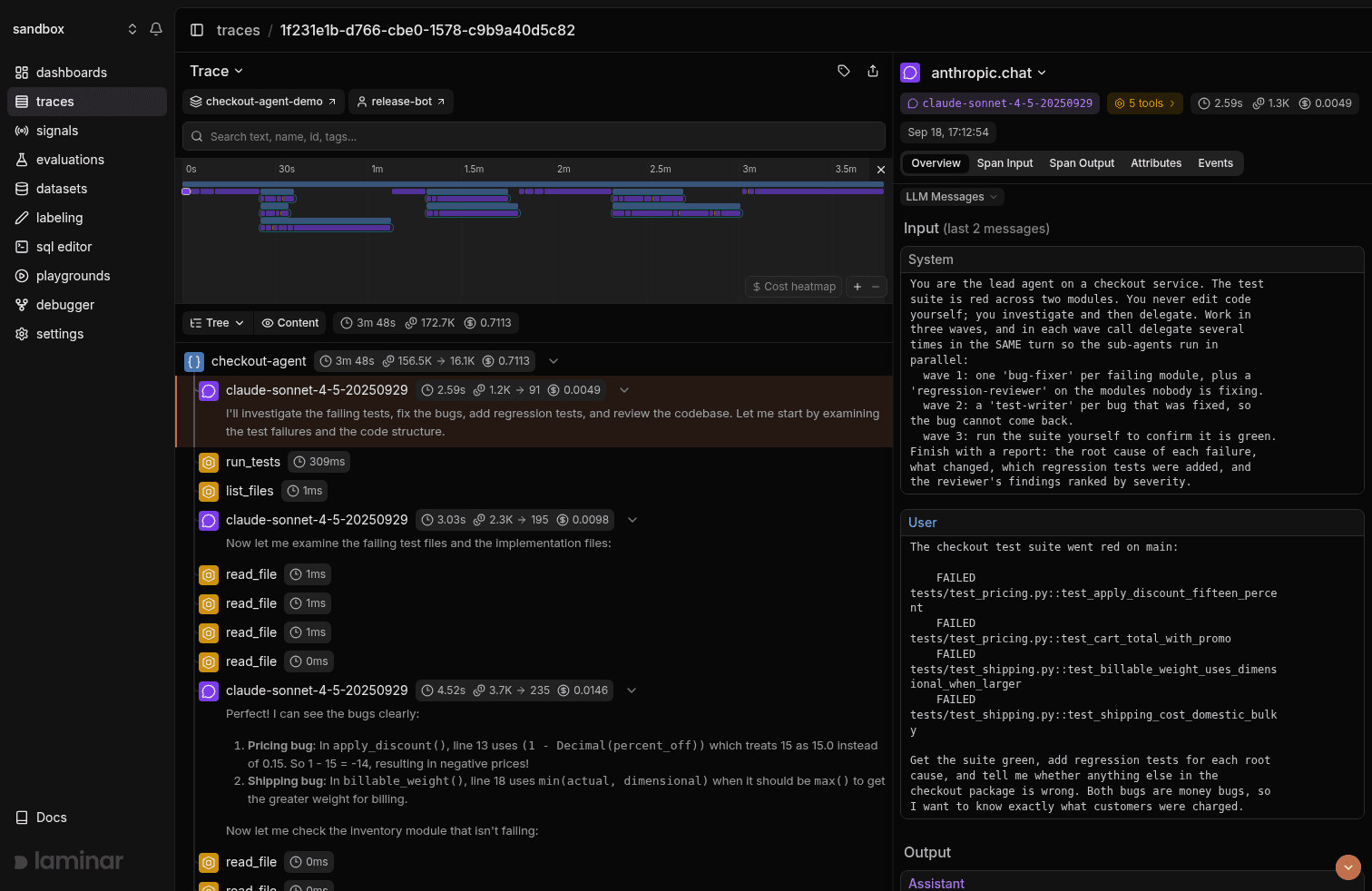
Open a 2,000-span agent trace in a generic tool and you get a tree. The tree tells you the shape of the run, not what happened in it. Laminar's transcript view is the default: what the agent said, what the user said back, what each tool call returned, rendered in order.
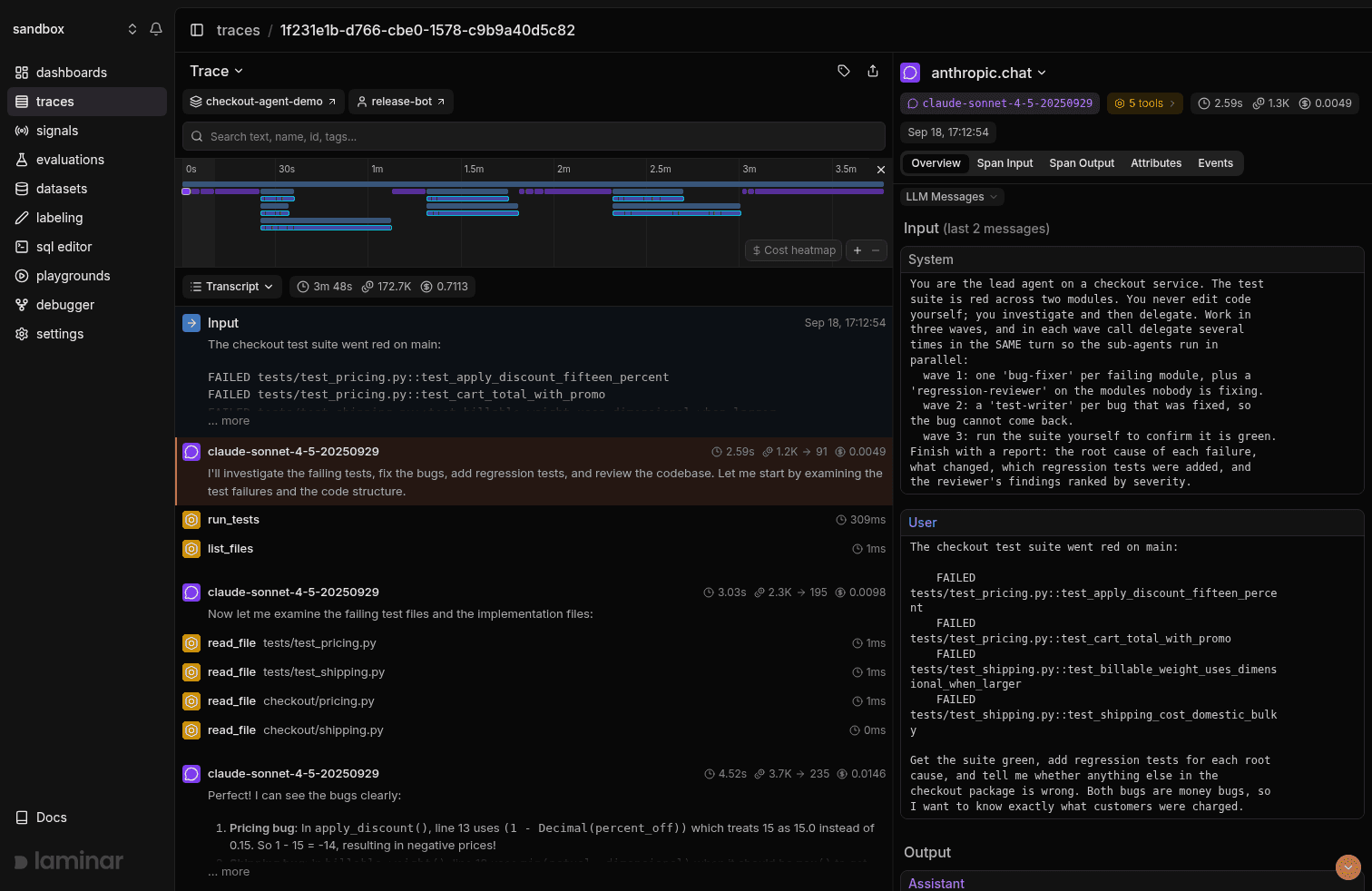
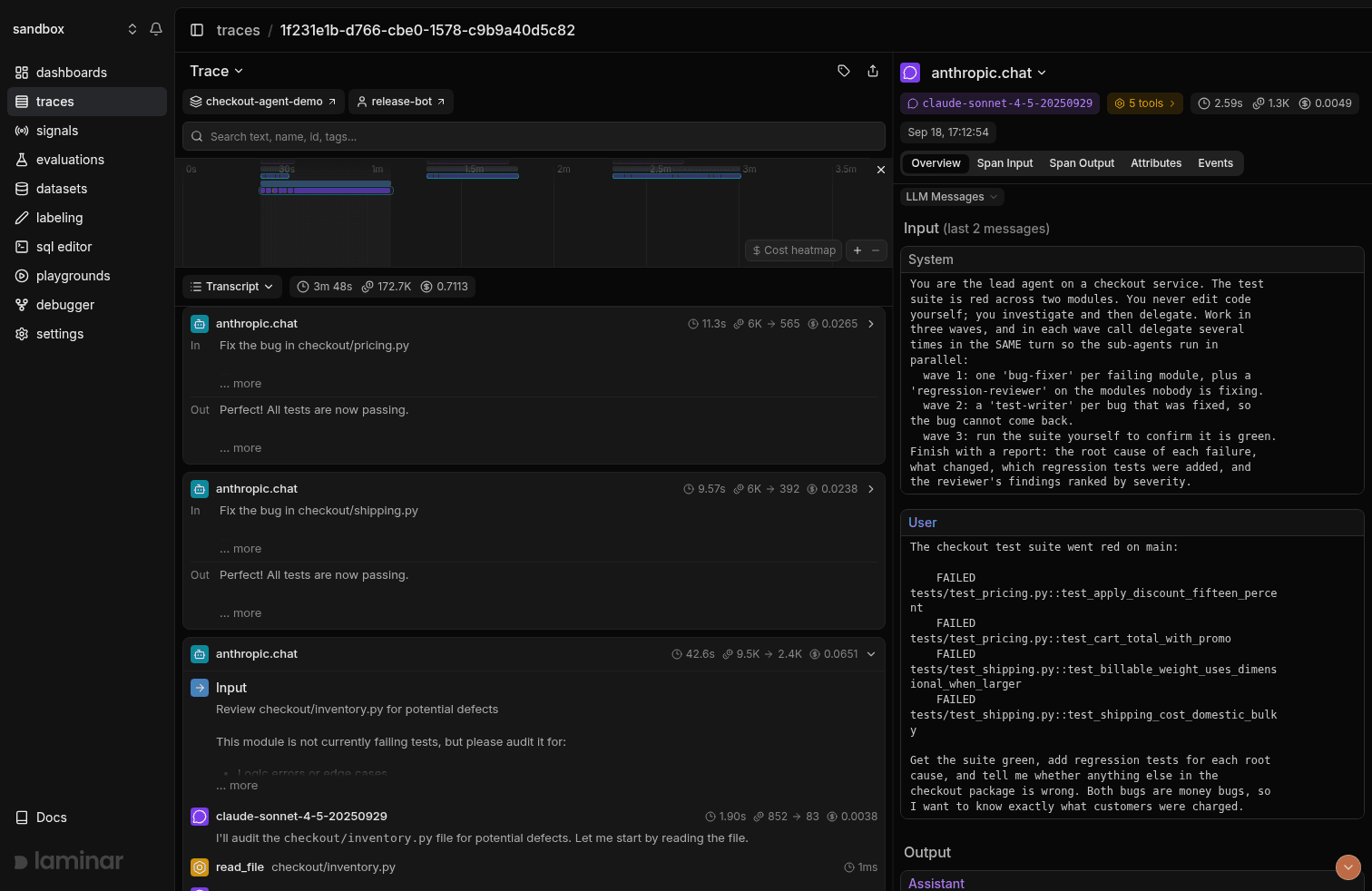
Sub-agents collapse into a single card until you want them. Expand one and its spans scope to it, so you read the sub-agent's own conversation without losing your place in the parent run.
The span tree and timeline are one click away when you do want the shape. The timeline is where you see what ran in parallel and where the wall-clock actually went.
20x trace compression, and the lowest pricing on the market
Agents re-send the full conversation on every turn, so a 30-turn run that has k unique messages carries on the order of k(k+1)/2 messages across its spans, the same context copied over and over. Generic tools store every copy. Laminar hashes each message, stores every unique message once per trace, and reconstructs the full trace byte-for-byte at query time: an average 20x reduction in storage, up to 50x on the longest runs (full write-up).
That is the foundation of the pricing. Because Laminar stores a fraction of the bytes, it can bill on data volume and still come in below everyone else.
Signals: read ten thousand traces without reading them
Signals turn a plain-language instruction plus a JSON schema into a structured event on every trace it matches. You write "agent looped on the same tool without making progress." Laminar extracts it, backfills across history, and fires on every new trace.
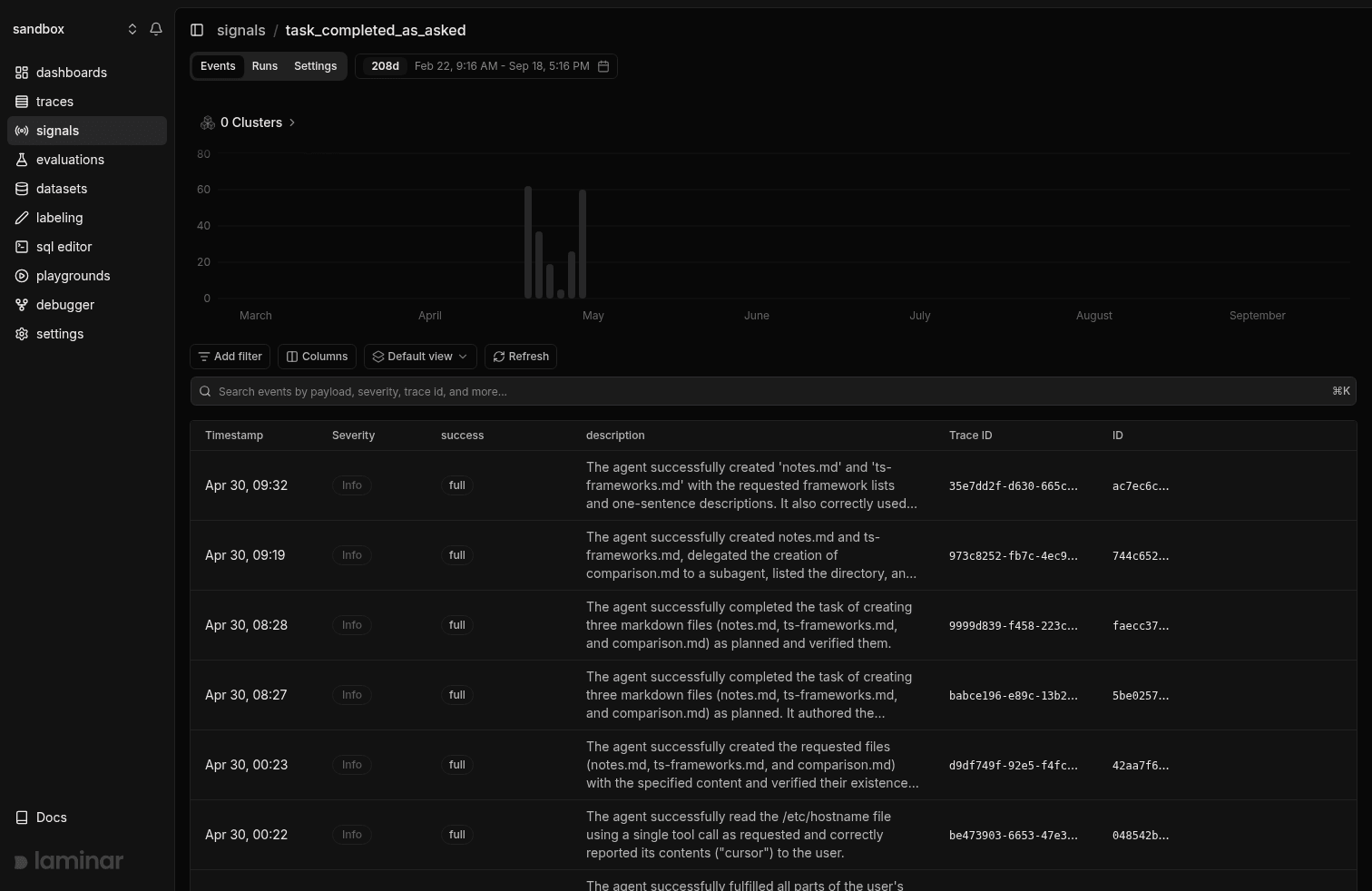
A Signal reads the whole trace, every LLM turn and tool call from first span to last, because most agent failures only make sense in the context of the entire run. One trace you can skim. Ten thousand you cannot, and Signals are how you answer questions across all of them.
Then clustering collapses the volume. Laminar groups extracted signal events by behavior, so instead of scrolling ten thousand events you see the ten things your agent actually does wrong, ranked by how often.
SQL over all platform data
Agent traces raise questions a dashboard was never going to answer. Laminar gives you raw SQL over traces, spans, signal events, evaluations, and metadata. "How many runs called tool X more than five times and then errored" is one query.
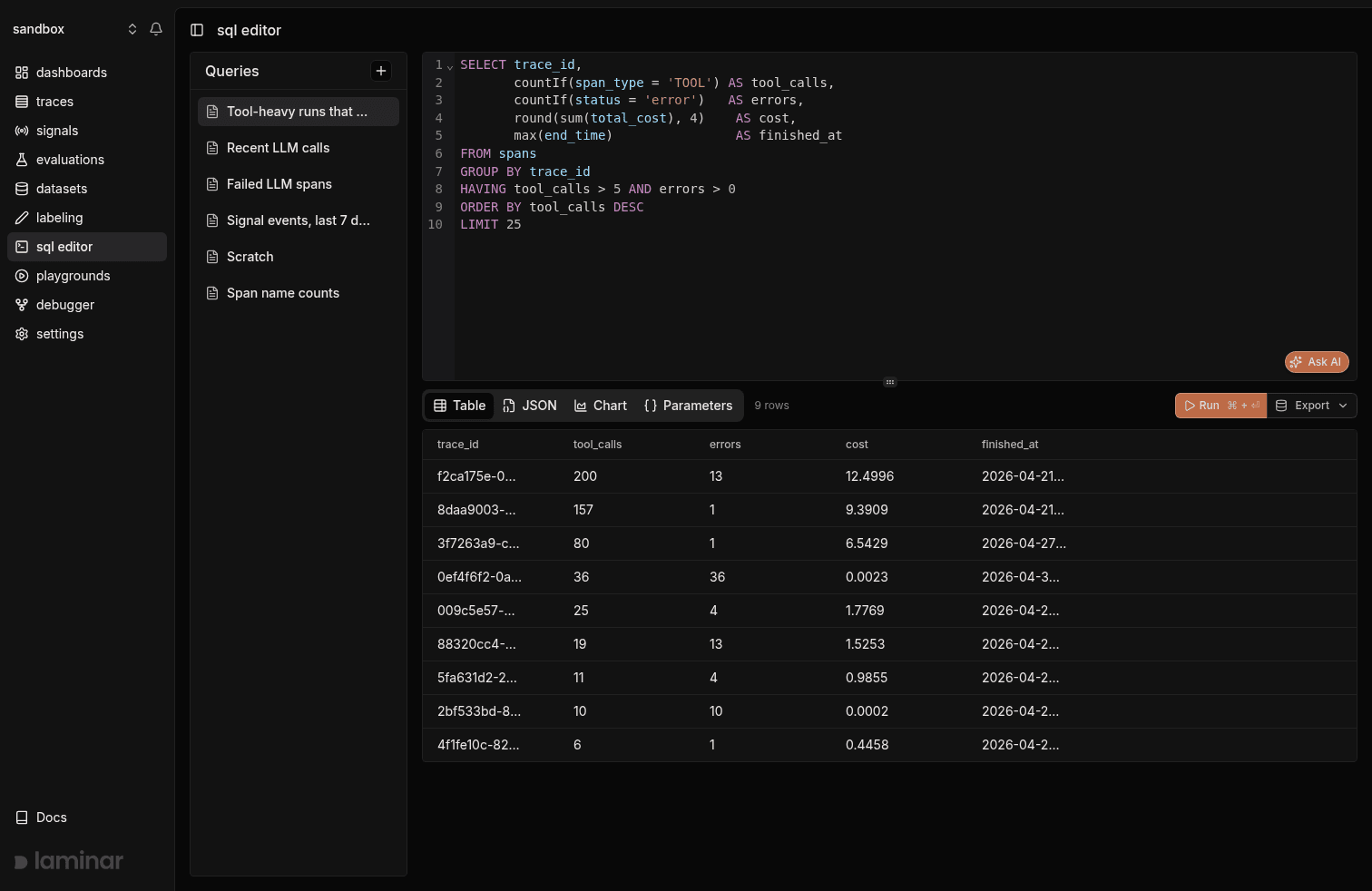
The same SQL is reachable wherever you or your coding agent work: the in-app editor, lmnr-cli sql query from the CLI, the MCP server, and the SQL API. No warehouse export.
A debugger your coding agent drives
Building an agent is a loop: run it, read what it did, change something, run it again. Laminar's debugger is that loop, built so Claude Code, Cursor, or Codex runs it through the Laminar CLI. Start your agent with LMNR_DEBUG=true and the run is traced into a session; the coding agent reads the trace, edits your code, and reruns.
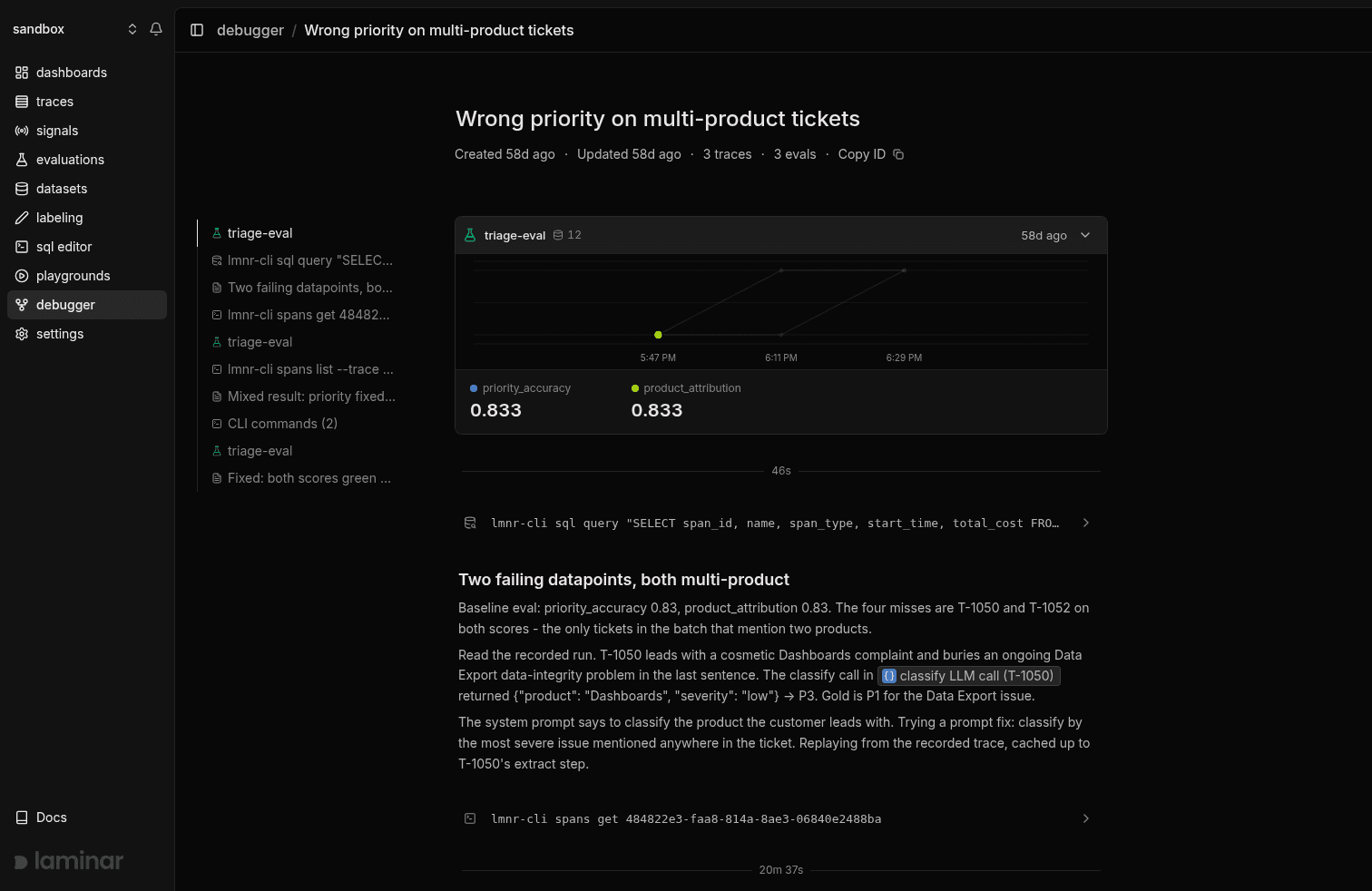
Each rerun is served from cache up to the point it is testing. The call you are fixing is often three-quarters of the way through a multi-minute run, so caching the prefix means the agent can take that turn dozens of times in the span it would take to run live once.
A code-first eval SDK
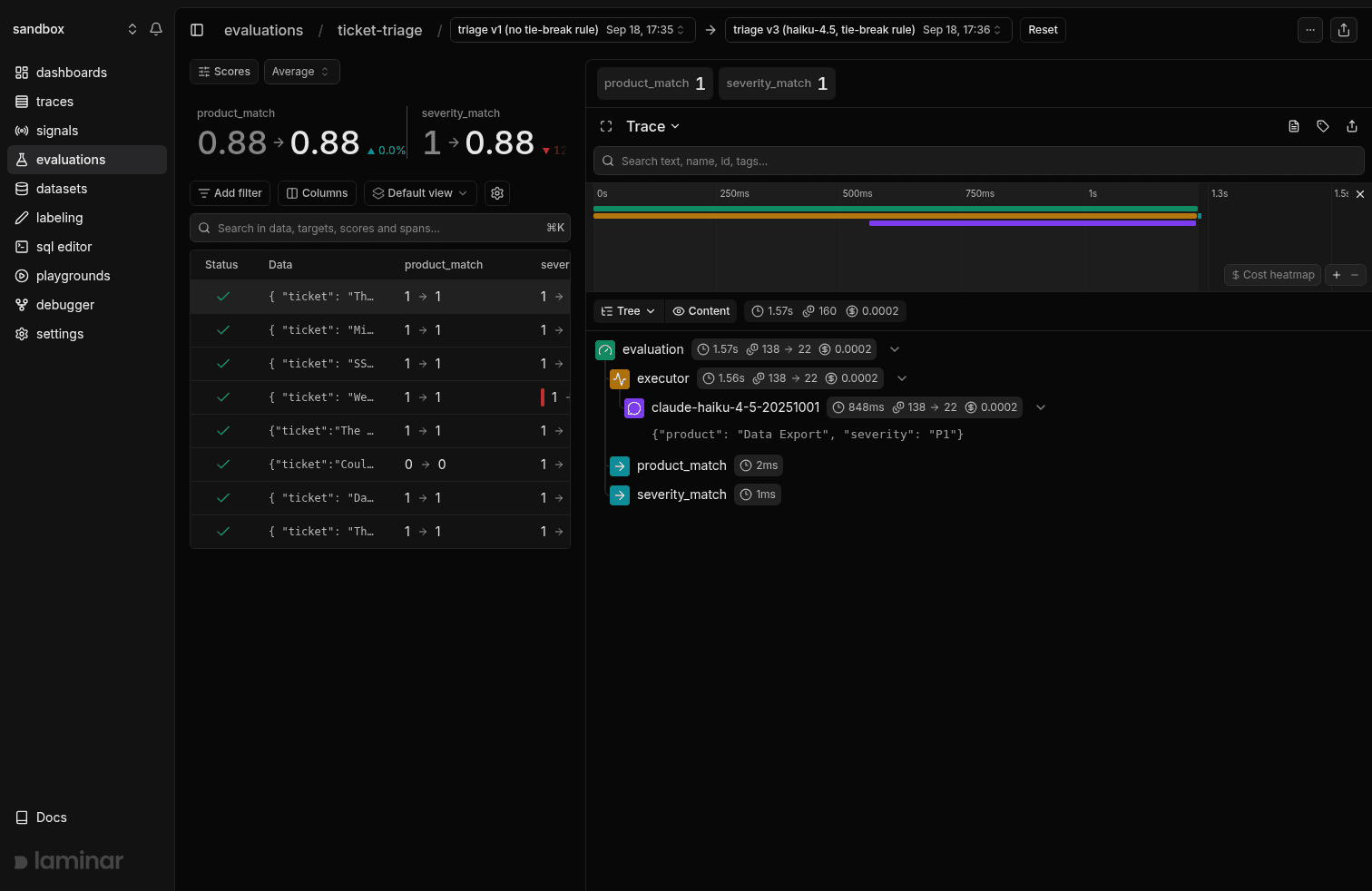
Laminar's evals follow a code-first, barebones-SDK philosophy: a dataset, an executor function (your agent or a piece of it), and evaluator functions that score the output, written in plain Python or TypeScript and run with python my_eval.py, tsx my-eval.ts, or lmnr eval. Because the SDK is thin, you can evaluate any part of an agent without contorting it into a prompt-and-scorer shape. Scores persist, so you can compare runs over time.
Ecosystem fit
Native SDKs for Python and TypeScript. Auto-instrumentation for LangChain, LangGraph, CrewAI, AutoGen, Claude Agent SDK, Browser Use, OpenAI Agents SDK, Vercel AI SDK, and raw OpenAI / Anthropic clients. Because it is OTel-native, any OpenInference or OpenLLMetry instrumentation also works.
Self-host story
Laminar is genuinely easy to self-host. The repo ships a production-ready Helm chart: clone, apply, and you are running. No enterprise sales call, no proprietary operator, no "contact us for self-host." The open-source build is the real product and not a reduced community edition: tracing, full-text search, dashboards, the SQL editor, the debugger, evals, datasets, and browser session recording are all in it. Signals and its email and Slack alerts are the enterprise additions and need a license key. That is unusual in this category.
Pricing
Data-volume pricing with no seat fees and no per-span unit counting. Free: 1GB/month, 7-day retention. Hobby: $30/month for 3GB then $2/GB, 30-day retention. Pro: $150/month for 10GB then $1.50/GB, 6-month retention, unlimited seats and projects. Enterprise is custom. Self-hosting is free. Because Laminar compresses agent traces ~20x before storing them, that data allowance holds far more real traffic than the raw number suggests.
Where Laminar is not the right pick
- You only log single LLM calls and do not have nested tool use. Simpler tools will do.
- Your entire workflow is prompt versioning and you do not run agents. Langfuse and LangSmith are more specialized there.
2. Langfuse
Category: Open-source LLM observability and prompt management. License: MIT. Deployment: Cloud, self-host. Repo: github.com/langfuse/langfuse.
Langfuse has one of the most explicit data models in the space: traces, observations, sessions, scores. Observations are typed (generations, spans, events), which makes complex flows tractable if you structure your instrumentation correctly.
Strengths:
- First-class prompt management with versioning.
- Mature evaluation harness and dataset workflows.
- Full OTLP ingestion endpoint; works as a generic OTel backend.
- Free, MIT-licensed self-host with all core features.
- Agent graph view (beta) for LangGraph-style workflows.
Weaknesses relative to agent debugging:
- Trace UX is built around observations, not agent conversations. Reading a 2,000-span agent run is slower than in Laminar.
- No built-in SQL editor. Analysis is API-first.
- No natural-language signal extraction across history, no trace compression.
- Agent graph view is still beta.
Pricing: Cloud Hobby is free with 50k observations. Core is $29/month. Pro is $199/month. Enterprise is $2,499/month. Usage is counted in billable units (traces + observations + scores), so agents with many small spans can add up fast. Full comparison: Langfuse alternatives 2026.
3. LangSmith
Category: LLM and agent observability from LangChain. License: Closed source. Deployment: Cloud, hybrid, self-hosted (Enterprise only).
If your stack is LangChain or LangGraph, LangSmith will give you the tightest out-of-the-box integration. One environment variable and every run is traced.
Strengths:
- LangGraph Studio. A real agent IDE. Visualize agent graphs, set breakpoints, modify state mid-trajectory, resume from a checkpoint. Nothing else in this list has a comparable purpose-built agent UI.
- LangSmith Deployment. Managed agent infrastructure with checkpointing, memory, and scaling.
- Full OpenTelemetry support (as of March 2026).
- Rich real-time dashboards, alerting, conversation clustering.
Weaknesses:
- Closed source. Self-hosting is an Enterprise-only add-on.
- Seat-based pricing ($39/seat/month on Plus) adds up for larger teams.
- Tightest fit is still LangChain and LangGraph. Teams on other frameworks get less.
- Trace retention tiering (14 days base, 400 days extended) complicates pricing.
Pricing: Developer plan is free with 5k base traces/month. Plus is $39/seat/month. Base traces cost $0.50 per 1k; extended traces (400-day retention) cost $2.50 per 1k. Full comparison: LangSmith alternatives 2026.
4. Arize Phoenix
Category: Open-source LLM tracing and evaluation, built on OpenTelemetry. License: Elastic License 2.0. Deployment: Self-host (pip install), Arize AX managed option.
Phoenix is the open-source side of Arize. It uses OpenInference, a set of OTel semantic conventions for LLMs that is widely adopted.
Strengths:
- OpenTelemetry-native with OpenInference conventions. Instrument once, send anywhere.
- Strong evaluation harness (Phoenix Evals).
- Good for notebook-first workflows; runs locally, spins up in Colab.
- Tight integration with Arize AX if you need production monitoring at enterprise scale.
Weaknesses:
- Trace UX is span-tree-first. Not built around agent conversations.
- Elastic License 2.0 is not OSI-approved open source.
- Commercial Arize AX has a different cost curve from open-source Phoenix. Plan ahead if you need to graduate.
Pricing: Phoenix open-source is free. Arize AX pricing is custom. Full comparison: Arize Phoenix alternatives 2026.
5. Weights & Biases Weave
Category: LLM tracing, evaluation, and experiment tracking. License: Closed source. Deployment: Cloud, on-prem for enterprise.
If your ML team is already on W&B, Weave fits in the same console. Trace LLM calls, run evals, compare experiments.
Strengths:
- Native integration with existing W&B workflows.
- Strong eval framework with scorers and comparisons.
- Good for teams that evaluate models and agents on the same platform.
Weaknesses:
- Less agent-first than Laminar or LangSmith. Trace UX is borrowed from ML experiment tracking.
- Weak on realtime trace viewing during long agent runs.
- Closed source.
Pricing: Free tier with limited storage. Paid plans scale with trace volume and seats.
6. Braintrust
Category: LLM evaluation platform with tracing. License: Closed source. Deployment: Cloud, on-prem for enterprise.
Braintrust is eval-first. Tracing exists to feed the eval loop, not to stand alone.
Strengths:
- Mature experiment harness: structured scorers, comparisons, regression detection.
- Strong for teams whose primary bottleneck is "did our change break behavior X."
- Clean prompt playground that ties into eval sets.
Weaknesses:
- Not a debugger. You will not be faster at finding what broke in production.
- Lighter agent-specific UX.
- Closed source, with a proprietary storage layer.
Pricing: Free tier available. Pro is $249/month; Enterprise is custom. Full comparison: Braintrust alternatives 2026.
Head-to-head: who wins each criterion
| Criterion | Winner | Why |
|---|---|---|
| Agent-specific UX | Laminar | Transcript view, 20x compression, Signals, coding-agent debugger, browser-agent replay. |
| Trace storage efficiency | Laminar | 20x average compression on agent traces, up to 50x on the longest runs. |
| LangGraph integration | LangSmith | LangGraph Studio is genuinely the best agent IDE available today. |
| Open-source self-host | Laminar / Langfuse (tie) | Laminar is Apache 2.0 with a one-command Helm chart and the full agent-debugging stack in the OSS build; Signals and its alerting need a license key. Langfuse (MIT) ships everything in its OSS build. |
| OpenTelemetry support | Laminar / Phoenix (tie) | Both OTel-native from day one. Phoenix uses OpenInference conventions. |
| Prompt management | Langfuse | Mature versioning, caching, and team workflows. |
| Eval SDK | Laminar / Braintrust (tie) | Code-first, versatile evals on both; Braintrust adds CI scorer sweeps. |
| Pricing predictability | Laminar | Data-volume pricing on compressed traces, no seat or per-span fees. |
How to pick an agent observability tool in under 5 minutes
Answer these in order. Stop at the first yes.
- Are you committed to LangGraph and want an agent IDE? → LangSmith.
- Are you shipping and debugging AI agents and want a transcript view, 20x compression, Signals, SQL, and a coding-agent debugger? → Laminar.
- Is your primary pain prompt versioning, not agent debugging? → Langfuse (OSS) or Braintrust (commercial).
- Do you need OpenInference and already run Arize for ML observability? → Phoenix.
- Is your team already on W&B? → Weave.
Open-source scorecard
Matters if you self-host, run in air-gapped environments, or want to own your data.
| Platform | OSS license | Self-host |
|---|---|---|
| Laminar | Apache 2.0 | Yes, Helm chart, one command (Signals needs a license key) |
| Langfuse | MIT | Yes, all features |
| Phoenix | Elastic 2.0 | Yes |
| LangSmith | Closed | Enterprise only |
| Weave | Closed | On-prem for enterprise |
| Braintrust | Closed | On-prem for enterprise |
OpenTelemetry scorecard
Matters if you already have an OTel pipeline or do not want to marry a specific vendor.
- Native OTel from day one: Laminar, Phoenix.
- Full OTLP endpoint: Langfuse, LangSmith (as of March 2026).
- Works via OpenLLMetry / OpenInference: most of the above, with varying fidelity.
If vendor neutrality matters, instrument once with OpenLLMetry or OpenInference and switch backends later without re-instrumenting. Instrumentation is a library call:
from traceloop.sdk import Traceloop

Traceloop.init(app_name="support-agent")
import * as traceloop from "@traceloop/node-server-sdk";

traceloop.initialize({ appName: "support-agent" });
The destination is configuration, not code. Point the same build at Laminar:
OTEL_EXPORTER_OTLP_ENDPOINT=https://api.lmnr.ai:8443
OTEL_EXPORTER_OTLP_HEADERS="authorization=Bearer $LMNR_PROJECT_API_KEY"
Swap those two variables for another vendor's OTLP endpoint and key and the spans land there instead. That portability is the whole argument for picking an OTLP-native platform: the cost of being wrong about this ranking is an environment variable, not a re-instrumentation project.
Why we still recommend Laminar
We built Laminar because none of the existing tools solved our own problem: debugging a 30-minute browser agent that failed at minute 18, with no idea which of 2,000 spans to look at first, and paying to store the same conversation re-sent on every one of those spans.
The transcript view was the first thing we built, then 20x compression so storing agent traffic stopped being the expensive part, then Signals because the failure mode you care about today is not the one your dashboards captured a month ago, then the debugger so the coding agent writing your agent could run the fix loop itself. Every one of those came from understanding agents, which is the thing LLM-first tools were not built around.
If you are shipping agents to production, these primitives are your day-to-day reality. Other tools can do pieces of this. None put them together in one product. That is the bias, and we think it is the right one.
Start with the free tier: 1GB of traces, 7-day retention. Instrument one agent. If you do not see the difference in the first hour, come back and tell us why.
Try Laminar free · Read the docs · Star on GitHub
FAQ
What is agent observability?
Agent observability is the practice of capturing, inspecting, and debugging the full execution of an AI agent, including every LLM call, tool call, retrieval, and sub-agent invocation. It differs from classical LLM observability because agent runs are long, non-deterministic, deeply nested, and re-send their full conversation on every turn. A good AI agent observability tool gives you a readable transcript of what the agent did, compresses the repeated context, tracks the outcomes that matter across every run, and lets a coding agent re-run the agent from any point.
What are the best AI agent observability tools in 2026?
Laminar is the best AI agent observability tool for teams shipping agents to production: open-source (Apache 2.0), OpenTelemetry-native, with 20x trace compression, transcript view, Signals, a coding-agent debugger, and SQL over all platform data. Langfuse is the best pick if prompt management is your core workflow. LangSmith is the best pick if you are committed to LangChain or LangGraph. Phoenix, Weave, and Braintrust each fit a narrower case: OpenInference-based tracing, W&B-native teams, and eval-first regression testing respectively.
What is the best open-source agent observability platform in 2026?
Laminar (Apache 2.0) is the best open-source agent observability platform for agents in production. It ships a Helm chart for one-command self-host, and the open-source build carries the full agent-debugging stack: transcript view, the SQL editor, the debugger, evals, and browser session recording. Signals and its email and Slack alerts need an enterprise license key. Langfuse (MIT) is the best pick if prompt management is your core workflow rather than agent debugging. Phoenix (Elastic 2.0) is strong for teams already on Arize or using OpenInference.
Do I need a dedicated agent observability tool, or is my APM enough?
APM tools like Datadog and New Relic can ingest OpenTelemetry spans, but they are built for service-level metrics, not conversational traces. They do not render agent runs as conversations, do not compress the re-sent context, do not support natural-language signal extraction over LLM content, and do not support a coding-agent debugger. If your agent is more than one LLM call deep, a purpose-built tool saves hours.
Is LangSmith better than Laminar?
LangSmith is the better pick if you are committed to LangChain or LangGraph and want LangGraph Studio. Laminar is the better pick for everyone else: it is open-source, OpenTelemetry-native, framework-agnostic, and built for AI agents from the ground up, with 20x trace compression, Signals, SQL over all platform data, and a coding-agent debugger.
How does Laminar compare to Langfuse?
Laminar is optimized for agents: transcript view, 20x trace compression, Signals, a coding-agent debugger, SQL over all platform data, and a code-first eval SDK. Langfuse is optimized for prompt management: versioned prompts, typed observations, an eval harness. Both are open-source. Pick Laminar if you are shipping and debugging agents; pick Langfuse if your workflow centers on prompt iteration. See the full Langfuse alternatives comparison.
Can I send OpenTelemetry traces to any of these platforms?
Laminar, Langfuse, LangSmith, and Phoenix all accept OpenTelemetry traces natively or via OTLP. Weave and Braintrust have partial OTel support. If vendor neutrality matters, instrument with OpenLLMetry or OpenInference and you can switch backends without re-instrumenting.
What does agent observability cost?
Pricing models vary. Laminar charges by data volume with no per-seat fees (Free: 1GB at 7-day retention; Hobby: $30/month for 3GB; Pro: $150/month for 10GB at 6-month retention; self-host is free) and compresses agent traces ~20x before storing them. Langfuse charges by billable units (traces + observations + scores). LangSmith charges per seat plus per trace. For agents with large traces, data-volume pricing on compressed data is usually the most predictable and the lowest cost.
Last updated: September 2026. Verify features and pricing against each vendor's current documentation before committing.